Researchers at Omdia surveyed 2,050 professionals worldwide who are actually driving the strategy, rollout and optimization of AI systems. Their global research uncovered:
Amid all the back-and-forth about the value of generative AI, organizations report success.
Bottom line: Organizations tell us gen AI is working, their investments are continuing and the ROI is there.
40%
Respondents who quantified their ROI on gen AI report earning $1.49 for every $1 invested.
Download e-Book
While agentic AI solutions are not widespread, and often are not yet very complex, our research shows that agents are already gaining traction among early gen AI adopters:
It is not surprising that early adopters of gen AI are taking their learnings to the agentic level. But it is significant that more tech-forward organizations may be opening up a sizable lead over competitors. Download the full report for details.
At orgs already using AI agents, the most common uses are:
An often-feared outcome of generative and agentic AI is that it will eliminate human jobs. And it has. Teams most often experiencing job loss due to gen AI in the past year were IT operations (at 40% of surveyed orgs), customer service/support (37%) and data analytics (37%). But that’s not the whole story.
See the report for more information on how job impacts affect seniority levels and more.
Share of businesses having seen both AI-related job creation and loss that report a net positive
The pivot to agentic enthusiasm does not mean that gen AI is now child’s play. While nearly every respondent reports that gen AI is returning value, 96% say that they grapple with significant issues, including:
For midsized companies, talent is a bigger challenge: 43% cited it as a problem, compared to 34% of enterprise respondents.
The blissful share of respondents who say they’ve had no problems implementing gen AI
Not sure where to start with Snowflake?
Talk to SIFT Analytics — and let us help you explore your use case and build a practical, scalable strategy that delivers real business results.
Connect with SIFT Analytics
As organisations strive to meet the demands of the digital era, SIFT remains steadfast in its commitment to delivering transformative solutions. To explore digital transformation possibilities or learn more about SIFT’s pioneering work, contact the team for a complimentary consultation. Visit the website at www.sift-ag.com for additional information.
About SIFT Analytics
Get a glimpse into the future of business with SIFT Analytics, where smarter data analytics driven by smarter software solution is key. With our end-to-end solution framework backed by active intelligence, we strive towards providing clear, immediate and actionable insights for your organisation.
Headquartered in Singapore since 1999, with over 500 corporate clients, in the region, SIFT Analytics is your trusted partner in delivering reliable enterprise solutions, paired with best-of-breed technology throughout your business analytics journey. Together with our experienced teams, we will journey. Together with you to integrate and govern your data, to predict future outcomes and optimise decisions, and to achieve the next generation of efficiency and innovation.
The Analytics Times
“The Analytics Times is your source for the latest trends, insights, and breaking news in the world of data analytics. Stay informed with in-depth analysis, expert opinions, and the most up-to-date information shaping the future of analytics.
Published by SIFT Analytics
SIFT Marketing Team
marketing@sift-ag.com
+65 6295 0112
SIFT Analytics Group
Explore our latest insights
SIFT provides Snowflake services that encompass the full spectrum of professional consulting, implementation, migration, and optimization solutions that help organizations deploy and maximize value from the Snowflake data cloud platform. These services address the complex technical and organizational challenges that arise when adopting a modern cloud data platform, including the design of modern data architectures that support scalable and accessible data for organizations.
This guide covers implementation services for new Snowflake deployments, migration consulting for transitioning from legacy systems, performance optimization for existing environments, and ongoing support models. It also highlights how Snowflake services impact data management and data analytics, enabling organizations to efficiently handle, process, and analyze large datasets. It excludes basic Snowflake platform features such as built-in compute and storage mechanics, focusing instead on the professional services layer that enables successful adoption. The target audience includes data engineering teams evaluating Snowflake adoption, IT leaders planning data warehouse modernization, analytics teams seeking to optimize existing deployments, and decision-makers assessing the investment required for Snowflake transformation.
Snowflake services provide end-to-end support spanning platform assessment, architecture design, data migration, performance tuning, cost optimization, and advanced AI/ML enablement—delivered through consulting engagements, managed services, or hybrid models tailored to organizational needs and internal capabilities.
Snowflake services deliver expert guidance and hands-on support for implementing, migrating, and optimizing Snowflake environments.
Additionally, Snowflake allows secure data sharing without copying or moving data, enabling live data access and real-time collaboration across organizations. This enhances the accessibility of data for analytics and decision-making.
By reading this guide, you will gain:
Snowflake services are professional consulting and technical implementation engagements that help organizations adopt, transform, and extract maximum value from the Snowflake cloud data platform. These services go beyond the platform’s native capabilities to address architecture design, data modeling, governance configuration, data pipelines development, security implementation, and the organizational change management required for successful adoption. Snowflake services enable organizations to build modern data architectures that integrate data from multiple data sources, enhancing data quality, accessibility, and operational efficiency to support business growth.
Organizations need specialized Snowflake consulting services because effective platform adoption requires expert judgment across multiple domains. While Snowflake abstracts many operational burdens through its separation of storage and compute, designing optimal micro-partitioning strategies, selecting appropriate warehouse sizes, configuring clustering keys, managing concurrency, and migrating complex legacy systems still demand deep expertise. Snowflake’s architecture is designed with three decoupled layers—Storage, Compute, and Cloud Services—enabling scalability, flexibility, and performance. Without this guidance, organizations risk wasted spend, poor query performance, governance gaps, and underutilized features that diminish return on investment.
SIFT Analytics is an award-winning, leading AI analytics consulting firm in ASEAN with over 27 years of experience helping organizations transform data into actionable insights. With deep expertise in AI, data automation, and digital transformation, SIFT Analytics empowers businesses to leverage Snowflake to accelerate intelligence in their data. As a trusted partner across industries, SIFT delivers innovative analytics solutions that drive measurable business outcomes and sustainable growth in an increasingly data-driven world.
Implementation services support organizations new to Snowflake, covering the complete journey from platform setup through production deployment. These services include cloud provider selection (AWS, Azure, or Google Cloud Platform), architecture design, security configuration, data modeling, and integration with existing analytics tools. Snowflake supports both structured and semi-structured data natively, enabling users to store and manage data in its original format without loss of information. Implementation engagements establish the foundation that determines long-term platform performance and cost efficiency.
Migration services address the complex challenge of moving from on-premises data warehouses, traditional databases, or other cloud platforms to Snowflake. This category encompasses legacy system assessment, ETL/ELT pipeline conversion, historical data transfer, schema translation, and validation testing. Migration services reduce risk and accelerate time-to-value when transitioning from legacy systems.
Optimization services help existing Snowflake customers improve performance, reduce costs, and adopt advanced features like Snowpark, Cortex AI, and machine learning capabilities. These services include query tuning, warehouse right-sizing, cost governance, monitoring enhancement, and training programs that build internal expertise.
Each service category addresses distinct organizational needs, yet they often overlap in practice—a migration engagement typically includes elements of both implementation and optimization to ensure the target environment performs optimally from day one.
Consulting-led implementations involve shorter, focused engagements where external experts work alongside internal teams to design architecture, execute proof-of-concept projects, and transfer knowledge. This model suits organizations with capable data engineering teams who need specialized expertise for specific challenges rather than ongoing support.
Managed services provide ongoing operations, monitoring, and optimization handled by external partners. This approach suits organizations that prefer to focus internal resources on business-specific analytics rather than platform operations, or those lacking sufficient Snowflake expertise to manage the environment independently.
Hybrid models combine consulting for initial implementation with managed services for ongoing operations, or provide advisory support while the client executes. This flexibility allows organizations to scale external involvement based on internal capability development and evolving needs.
The delivery model significantly influences project cost, timeline, risk profile, and required internal resources—making this choice as important as the services themselves.
Building on the core categories outlined above, each service type encompasses specific deliverables and technical activities that address distinct phases of the Snowflake adoption lifecycle.
Architecture design and platform setup establishes the technical foundation for all subsequent work. This includes selecting the appropriate cloud provider and regions, configuring network connectivity and security boundaries, designing the account hierarchy for multi-team or multi-business unit deployments, and establishing infrastructure-as-code practices using tools like Terraform. Snowflake’s unique architecture allows for dynamic modification of configurations and independent scaling of resources, optimizing performance without manual resource management. Decisions made during architecture design directly impact performance, security, and costs for years to come.
Data modeling and warehouse design consulting translates business requirements into optimal schema structures. Consultants help determine whether star or snowflake schemas best suit analytics requirements, design approaches for semi-structured data using Snowflake’s VARIANT type, establish clustering key strategies, and configure virtual warehouses sized appropriately for different workload types. Snowflake supports semi-structured data formats like JSON, Avro, XML, and Parquet, enabling schema-less storage and automatic discovery of attributes for better data access. Effective data modeling enables users to query data efficiently and generate insights quickly.
Security configuration and governance implementation ensures the platform meets organizational and regulatory requirements. This includes configuring role-based access control, implementing row and column-level security, establishing data masking policies, setting up audit logging, and integrating with identity management systems. Strong governance from the start prevents costly remediation later.
Integration with existing data tools and BI platforms connects Snowflake to the broader analytics ecosystem. Implementation services configure connections to BI tools like Tableau, Power BI, and Qlik, establish the ability to connect multiple data sources and create complex data pipelines for comprehensive analytics using Snowpipe or third-party ETL platforms, integrate version control and CI/CD practices, and enable data sharing capabilities across business units or external partners. Organizations can also create data products and workflows within Snowflake to support advanced analytics and operational needs.
Legacy data warehouse assessment and migration planning evaluates the current state and designs the transition path. Consultants profile existing schemas, data volumes, and growth patterns; assess technical debt in SQL scripts and stored procedures; identify dependencies and compliance requirements; and determine whether a lift-and-shift or rearchitecture approach best serves organizational goals.
ETL/ELT pipeline conversion and optimization transforms existing data pipelines for the Snowflake environment. This includes converting code from platforms like SSIS or Informatica, refactoring batch processes for streaming where beneficial, and optimizing pipeline logic to leverage Snowflake’s architecture for processing data more efficiently.
Data validation and testing services ensure migration accuracy and completeness. Validation activities include checksum verification, record count reconciliation, referential integrity testing, sampling comparisons, and performance benchmarking against legacy system baselines. Snowflake services are also used to analyze data for accuracy and performance after migration, supporting advanced analytics and ensuring data-driven decision-making.
Cutover planning and execution support manages the transition to production use. This encompasses defining freeze windows, implementing incremental synchronization, establishing rollback procedures, coordinating with stakeholders, and providing go-live monitoring to address issues quickly. When planning migration cutover and testing, it is important to consider that Snowflake compute usage is billed on a per-second basis, with a minimum billing duration of 60 seconds.
Performance tuning and cost optimization consulting helps organizations reduce spend while improving query performance. Consultants analyze query profiles, implement automatic clustering where beneficial, configure search optimization and materialized views, right-size warehouses, and establish resource monitors and usage governance. Snowflake consulting often includes comprehensive health checks of existing environments to evaluate operational excellence, security, reliability, performance efficiency, and cost optimization. Recent Snowflake improvements have reduced query duration for recurring workloads by approximately 27% through platform enhancements alone—optimization services help organizations capture these benefits fully.
Advanced feature implementation enables capabilities like Snowpark for custom code execution, Cortex AI for generative AI applications, and Snowflake ML for machine learning workflows. With Snowpark, developers can use familiar programming languages like Python, Java, and Scala to implement custom business logic and perform data transformations and machine learning tasks directly in Snowflake, enhancing operational efficiency. These services help data scientists and engineers build AI-powered applications using enterprise data, implement feature stores, establish model registries, and deploy AI models within the governance framework. Cortex AI significantly reduces time-to-insight from days to seconds by utilizing intelligent automation and natural-language data interaction, helping organizations innovate faster.
Monitoring and governance enhancement establishes observability across the data platform. This includes configuring lineage tracking, implementing AI observability for ML workflows, establishing metadata management practices, and ensuring audit capabilities meet compliance requirements. The platform’s elastic scalability allows organizations to adjust capacity and performance on demand, eliminating the need for upfront capacity planning and maintenance of underutilized resources.
Training and knowledge transfer programs build internal capabilities for long-term self-sufficiency. Programs range from technical workshops for data engineering teams to executive briefings on platform capabilities, often including the establishment of Centers of Excellence that institutionalize best practices.
These optimization services collectively ensure organizations extract maximum value from their Snowflake investment, whether through reduced costs, improved performance, or accelerated innovation through advanced features. These capabilities help organizations innovate faster and maintain operational excellence.
Successful Snowflake engagements follow a structured process that aligns technical activities with business objectives, regardless of whether the focus is new implementation, migration, or optimization.
Assessment and Planning: The engagement begins with a thorough assessment of current data architecture, business requirements, and desired outcomes. This phase also involves leveraging Snowflake’s global network—a widespread, cloud-based infrastructure that enables organizations to mobilize, share, and analyze data collaboratively across teams and regions, supporting diverse analytic workloads at scale.
ROI Analysis and Cost Estimation: Teams estimate the potential return on investment by modeling expected performance improvements, scalability, and operational efficiencies. It’s important to note that Snowflake offers a flexible pricing model, allowing users to pay only for the computing and cloud storage they actually use, with options for on-demand per-second pricing or pre-purchased capacity. Additionally, Snowflake provides a free trial period so potential users can explore its features before committing to a paid plan.
Solution Design: Architects design the Snowflake environment, including data models, security policies, and integration points with existing systems.
Implementation: The technical team provisions Snowflake accounts, configures virtual warehouses, and migrates or ingests data. Automation and best practices are applied to streamline deployment.
Testing and Validation: Data pipelines, security controls, and performance benchmarks are validated to ensure the solution meets requirements.
Training and Handover: End users and administrators receive training on Snowflake features, query optimization, and ongoing management.
Ongoing Optimization: Post-launch, teams monitor usage, tune workloads, and implement enhancements to maximize value.
This phase is critical for migrations from large legacy systems, organizations entering regulated industries, deployments requiring AI and machine learning capabilities, or any engagement where cost discipline is mandated.
Current state data architecture analysis maps existing data sources, data flows, schemas, volumes, and growth patterns. This analysis identifies bottlenecks, concurrency issues, and technical debt that must be addressed during implementation or migration.
Business requirements gathering and prioritization identifies key use cases, data consumers, and analytics requirements. This includes defining service level expectations for query latency and data freshness, documenting compliance requirements, and prioritizing workloads for phased implementation.
Technical feasibility assessment evaluates infrastructure considerations including cloud provider alignment with organizational standards, network bandwidth for data transfer, integration requirements with existing tools, and the need for specific capabilities like real-time data processing or secure data sharing.
Migration strategy and timeline development defines the implementation approach, whether lift-and-shift or rearchitecture, establishes pilot phases and production rollout milestones, identifies freeze windows for cutover, and creates stakeholder communication plans.
ROI analysis and cost estimation projects credit consumption, storage costs, data transfer expenses, and professional services fees while modeling expected savings from retiring legacy systems, reducing administrative overhead, and accelerating time to insights.
Self-service approaches suit organizations with experienced Snowflake teams seeking maximum control and willing to invest significant internal resources. The risk of suboptimal configuration is highest without external expertise.
Consulting-led engagements balance external expertise with internal involvement, providing knowledge transfer while reducing implementation risk. This approach works well for organizations building internal capabilities.
Fully managed services minimize internal resource requirements and leverage provider expertise for fastest time-to-value, though they require careful vendor selection and ongoing oversight to ensure alignment with organizational needs.
Selection criteria should weight cost constraints, timeline requirements, internal skill levels, regulatory complexity, data volumes, and the strategic importance of building internal expertise versus focusing resources on business-specific analytics.
Implementation and optimization engagements consistently encounter several challenges that require proven approaches to address effectively. Snowflake services are particularly valuable in supporting research activities within regulated industries, such as financial institutions, by enabling secure, compliant, and efficient data access. This capability accelerates data-driven insights, enhances AI/ML initiatives, and streamlines compliance efforts.
Historical data often presents significant challenges: inconsistent formats, schema drift over time, large volumes requiring extended transfer windows, and compliance requirements for data retention.
Solution: Implement phased migration approaches that prioritize hot data for immediate transfer while scheduling warm and cold historical data for subsequent phases. Use compression and native extractors to accelerate transfer, employ staging environments for validation, and leverage automated tools like code conversion accelerators to reduce manual effort. Establish comprehensive validation frameworks using checksums, record counts, and referential integrity tests to verify accuracy before cutover.
Snowflake’s consumption-based pricing model requires active management to avoid unexpected costs from warehouse sizing, query patterns, and feature usage.
Solution: Implement resource monitors and budget alerts from the start. Right-size warehouses based on workload analysis rather than assumptions, configure auto-suspend and auto-resume appropriately, and separate workloads to prevent resource contention. Recent platform improvements have reduced maintenance costs for Search Optimization Service and Materialized Views by approximately 80%, making these performance features more cost-effective. Establish governance processes that balance performance optimization with cost awareness, using Account Usage metrics to identify optimization opportunities.
Internal teams may lack experience with Snowflake’s architectural patterns, query optimization approaches, and advanced features like Snowpark and Cortex AI.
Solution: Develop structured training programs covering both technical skills and platform concepts. Establish internal Centers of Excellence to institutionalize best practices and provide ongoing guidance. Start with pilot projects that deliver visible wins to build confidence and demonstrate value. Include cross-functional stakeholders—data engineering, security, compliance, and business analysts—early in the process to ensure broad adoption. Document standards, patterns, and lessons learned to accelerate future projects and reduce dependency on external expertise.
Snowflake services span the complete lifecycle from initial assessment through implementation, migration, optimization, and ongoing support. Selecting the right combination of services and delivery models depends on organizational maturity, internal capabilities, timeline requirements, and strategic priorities for building versus buying expertise.
To move forward with your Snowflake initiative:
Related topics to explore include Snowflake cost optimization strategies for consumption management, advanced analytics implementation covering Cortex AI and machine learning capabilities, and data governance best practices for maintaining compliance as your data platform scales.
Interested to start with Snowflake?
Talk to SIFT Analytics — and let us help you explore your use case and build a practical, scalable strategy that delivers real business results.
Connect with SIFT Analytics
As organisations strive to meet the demands of the digital era, SIFT remains steadfast in its commitment to delivering transformative solutions. To explore digital transformation possibilities or learn more about SIFT’s pioneering work, contact the team for a complimentary consultation. Visit the website at www.sift-ag.com for additional information.
About SIFT Analytics
Get a glimpse into the future of business with SIFT Analytics, where smarter data analytics driven by smarter software solution is key. With our end-to-end solution framework backed by active intelligence, we strive towards providing clear, immediate and actionable insights for your organisation.
Headquartered in Singapore since 1999, with over 500 corporate clients, in the region, SIFT Analytics is your trusted partner in delivering reliable enterprise solutions, paired with best-of-breed technology throughout your business analytics journey. Together with our experienced teams, we will journey. Together with you to integrate and govern your data, to predict future outcomes and optimise decisions, and to achieve the next generation of efficiency and innovation.
The Analytics Times
“The Analytics Times is your source for the latest trends, insights, and breaking news in the world of data analytics. Stay informed with in-depth analysis, expert opinions, and the most up-to-date information shaping the future of analytics.
Published by SIFT Analytics
SIFT Marketing Team
marketing@sift-ag.com
+65 6295 0112
SIFT Analytics Group
Explore our latest insights
Singapore businesses generate massive volumes of data daily—yet most struggle to convert this information into strategic advantage. Data analytics consulting bridges this gap, transforming raw datasets into actionable insights that drive measurable business outcomes.
SIFT Analytics Group brings over 27 years of experience helping ASEAN enterprises unlock the full potential of their data. Since 1999, we’ve partnered with organisations and strategic partners across Singapore, Thailand and Vietnam to deliver end-to-end solutions in artificial intelligence, business intelligence, data automation, and digital transformation. Our team takes time to learn about each client’s business and operational workflows, combining deep technical expertise with practical business understanding to create analytics strategies that align with your specific objectives. We value partnership with our clients and industry partners to deliver tailored solutions that address unique business challenges.
Whether you’re a multinational corporation seeking advanced analytics capabilities or an SME ready to establish your first data-driven processes, our consultants provide the specialized knowledge and support needed to achieve tangible results. Our solutions are appropriately priced and tailored for small and medium-sized enterprises to ensure accessibility and value.
Singapore’s position as ASEAN’s digital hub creates both opportunities and challenges. According to the 2025 National Business Survey, 80% of local businesses are actively engaged in digital transformation, with 68% planning to prioritize AI and 45% focusing on data analytics over the next 12 months. However, research from ISCA, SIT, and RSM reveals that more than 69% of Singapore SMEs have not adopted data analytics in any meaningful way—leaving substantial competitive advantage unrealized.
Competitive Advantage
In Singapore’s fast-paced digital economy, data-driven companies consistently outperform their traditional competitors. Firms that utilize data analytics can unlock measurable outcomes such as increased productivity and profitability, enabling them to respond faster to market trends and customer preferences.
Regulatory Compliance
Governance and compliance with local regulations like the Personal Data Protection Act (PDPA) and MAS TRM Guidelines is essential in data analytics consulting. Professional consultants ensure your analytics infrastructure meets all regulatory requirements while maximizing data utility.
Cost Optimization
The implementation of data analytics services can help organizations identify trends, optimize operations, and improve customer experiences, ultimately enhancing business performance. Current SAP-Oxford Economics research shows Singapore businesses achieving approximately 16% ROI on AI initiatives, with projections reaching 29% within two years.
Risk Management
Predictive models in data analytics help anticipate financial risks, fraud, and potential equipment failures before they occur. This proactive approach protects organizations from costly disruptions and compliance violations.
Market Expansion
For businesses seeking growth across ASEAN markets, analytics provides critical insights into diverse consumer behaviors, logistics optimization, and regulatory requirements across borders. Data becomes a strategic asset for informed expansion decisions.
Professional analytics consulting ensures maximum return on your data investments by combining technical expertise with business acumen. Consultants help bridge the data skills gap by providing immediate access to specialists in data science, machine learning, and visualization.
Large Singapore corporations and multinational organizations require comprehensive analytics frameworks that scale across departments and geographies. Our enterprise services include:
A data strategy is essential for SMEs to leverage their data as a competitive advantage, enabling them to make informed decisions and optimize operations. This principle applies equally to enterprises, where fragmented data across business units often limits organizational effectiveness.
Many SMEs possess more data than they realize, but often struggle with data that is unstructured and disconnected from critical decision-making processes. Our SME-focused services address these challenges with:
SME AI adoption in Singapore has surged from 4.2% to 14.5% between 2023 and 2024—a threefold increase that demonstrates growing recognition of analytics value. Implementing a robust data strategy allows SMEs to transform scattered information into actionable insights, which can significantly enhance business performance.
Data analytics consulting services in Singapore encompass offerings from data strategy and governance to technical machine learning implementation and real-time reporting. Here are the core solutions we deliver to clients across industries:
Data analytics services involve collecting, processing, and analyzing data to extract valuable insights that drive decision-making, including data mining, advanced analytics, artificial intelligence, predictive analytics, and reporting.
A structured approach in data analytics consulting starts with understanding the business needs, mapping the current data landscape, and identifying gaps to connect data directly to decision-making processes. Consulting firms in Singapore typically offer end-to-end support across the data lifecycle, which includes data strategy, engineering, business intelligence, advanced analytics, and compliance.
Every successful analytics initiative begins with understanding where you stand today. Our assessment phase includes:
This foundation ensures our recommendations address your specific challenges rather than applying generic solutions.
With clear understanding of your current state and objectives, we develop a practical roadmap:
Our technical team executes the plan with attention to both system performance and business integration:
Sustainable analytics success requires organizational capability, not just technology:
Engaging in partnerships with academic institutions can provide organizations access to a pipeline of talent and innovative solutions, fostering a culture of data-driven decision-making.
Our track record spans enterprises and public sector organizations across Singapore and ASEAN. Here’s what our clients say about working with SIFT Analytics:
“SIFT’s predictive analytics implementation transformed our risk management capabilities. We now identify potential compliance issues weeks before they materialize, reducing our exposure significantly while improving regulatory relationships.”
— Senior Risk Director, Singapore Banking Institution
“The customer analytics platform delivered insights we simply couldn’t access before. Understanding purchase patterns across our Singapore locations helped us optimize inventory and improve customer retention by 23% in the first year.”
— Operations Head, Retail Chain
“Working with SIFT’s team, we automated reporting processes that previously consumed three full-time staff members. The efficiency gains allowed us to redirect those resources toward production innovation.”
— Manufacturing Operations Manager
“The data-driven approach SIFT helped us establish has fundamentally changed how we develop and evaluate public service programs. Evidence-based policy is now embedded in our decision-making culture.”
— Policy Director, Government Agency
Collaborative partnerships in data analytics can lead to improved efficiency and performance, allowing organizations to better utilize their data assets for decision-making.
Project timelines vary based on scope and complexity. Basic implementations—including data audits, governance frameworks, and initial dashboards—typically require 2-3 months. Enterprise transformations involving multiple business functions, machine learning deployment, and full-scale automation may extend to 9-12 months or longer. We establish clear milestones and deliverables regardless of project duration, ensuring you see measurable value throughout the engagement.
Data analytics consulting is crucial for navigating Singapore’s competitive landscape, especially in sectors like finance, retail, and healthcare. Our industry experience spans:
Yes. Analytics systems require ongoing attention to maintain value. We offer maintenance packages that include:
Key services in data analytics consulting include strategy development, data quality management, and compliance with local regulations like PDPA and MAS.
Data protection is fundamental to our practice. Our approach includes:
Partnerships in analytics can enhance an organization’s ability to tackle complex challenges by leveraging specialized knowledge from various fields such as mathematics, statistics, and data science.
SIFT Analytics Group has helped Singapore, Thailand and Vietnam enterprises turn data into strategic advantage since 1999. Our 27 years of experience across ASEAN markets means we understand not just the technology, but the business, regulatory, and cultural contexts that determine analytics success.
Data analytics consulting in Singapore helps businesses turn raw data into actionable insights, focusing on AI, machine learning, and cloud-based BI solutions. Whether you’re ready to establish foundational analytics capabilities or advance to sophisticated AI-powered systems, our team provides the expertise, tools, and support to achieve your objectives.
Effective data analytics consulting involves transforming raw data into actionable insights through advanced techniques such as machine learning and predictive modeling. Let’s discuss how we can help your organization unlock the value in your data.
Ready to transform your business? Talk with our team about your data analytics needs and discover how we can help you achieve actionable insights.
Connect with SIFT Analytics
As organisations strive to meet the demands of the digital era, SIFT remains steadfast in its commitment to delivering transformative solutions. To explore digital transformation possibilities or learn more about SIFT’s pioneering work, contact the team for a complimentary consultation. Visit the website at www.sift-ag.com for additional information.
About SIFT Analytics
Get a glimpse into the future of business with SIFT Analytics, where smarter data analytics driven by smarter software solution is key. With our end-to-end solution framework backed by active intelligence, we strive towards providing clear, immediate and actionable insights for your organisation.
Headquartered in Singapore since 1999, with over 500 corporate clients, in the region, SIFT Analytics is your trusted partner in delivering reliable enterprise solutions, paired with best-of-breed technology throughout your business analytics journey. Together with our experienced teams, we will journey. Together with you to integrate and govern your data, to predict future outcomes and optimise decisions, and to achieve the next generation of efficiency and innovation.
The Analytics Times
“The Analytics Times is your source for the latest trends, insights, and breaking news in the world of data analytics. Stay informed with in-depth analysis, expert opinions, and the most up-to-date information shaping the future of analytics.
Published by SIFT Analytics
SIFT Marketing Team
marketing@sift-ag.com
+65 6295 0112
SIFT Analytics Group
Explore our latest insights
An AI Data Cloud is a unified, cloud-native platform that centralizes, manages, and analyzes large amounts of structured and unstructured data to support AI and machine learning workloads. At its core, the definition of an AI data cloud emphasizes establishing precise business meanings and relationships within data, which is crucial for building accurate context and enabling AI agents to interpret information correctly. This convergence of artificial intelligence, cloud computing, and data management platforms enables organizations to process, analyze, and derive insights from massive datasets at scale—transforming how enterprises approach digital transformation in the agentic era by leveraging the power of advanced AI and cloud infrastructure.
This guide covers end-to-end data workflows and solutions, including cloud-native AI platforms, data integration strategies, machine learning workflows, and enterprise implementation approaches. It excludes legacy on-premises solutions and basic cloud storage, focusing instead on intelligent infrastructure that powers modern business operations. Enterprise services encompass a wide range of integrated solutions designed to enhance operational efficiency and support strategic initiatives within large organizations. IT leaders, data scientists, and digital transformation executives seeking to modernize their entire data estate will find actionable frameworks for vendor selection, implementation planning, and ROI optimization. The content matters because 87% of large enterprises have now adopted AI in production, yet only 14% have achieved the cloud maturity needed to fully leverage these capabilities.
Direct answer: AI data cloud combines cloud computing infrastructure with artificial intelligence capabilities to provide scalable, intelligent data processing and analytics solutions that break down data silos and enable organizations to answer complex questions across their entire data ecosystem. This means organizations can achieve faster insights and improved operational efficiency.
Key outcomes from this guide:
AI data cloud represents an integrated platform combining cloud storage, compute resources, AI/ML services, and data processing engines into a cohesive system. A clear definition of business terms and relationships within data is crucial, as it enables AI agents to interpret information accurately and perform effective reasoning across complex enterprise environments. The AI data cloud works by automating complex tasks, optimizing storage, and offering real-time insights through the seamless integration of AI into cloud infrastructure. For modern enterprises facing exponential data growth and competitive pressure for real-time insights, this integration has evolved from optional enhancement to essential infrastructure, powered by high-performance computing and advanced AI infrastructure.
Cloud-native data storage layers form the foundation of any AI data cloud platform. These include data lakes for raw unstructured data, data warehouses optimized for structured analytics, and lakehouses that combine both capabilities. AI data cloud platforms enable organizations to manage and analyze vast amounts of data across various environments, providing scalability and flexibility for data-driven decision-making. The system works by aggregating data from multiple sources, enriching it through automated processes, and enabling advanced search capabilities, which together support efficient AI and data management solutions.
The AI/ML service layer sits atop storage, providing access to foundation models including large language models, training environments, feature stores, and inference engines. AI cloud services for data management provide advantages such as automated data cleansing, predictive analytics, and enhanced security, which reduce manual effort and costs. Machine learning models can automatically categorize data based on content and context to ensure quick retrieval and compliance.
Cloud platforms enable AI systems to manage rapidly growing datasets, allowing scalability without a proportional increase in manual resources or hardware investment. The power of the underlying infrastructure—including high-performance computing resources, GPUs, and optimized AI software stacks—supports demanding AI workloads and underpins advanced technologies. Organizations can use a pay-per-use model with AI data clouds, which avoids significant upfront capital expenditure for AI hardware. This economic model has made enterprise-grade AI capabilities accessible to companies of all sizes.
The integration of AI capabilities into data cloud platforms allows for advanced analytics, enabling users to derive insights and automate processes more efficiently. The analytics layer works by aggregating, enriching, and analyzing data to automate and deliver actionable insights in real time. Embedded AI capabilities include natural language processing for conversational interfaces, predictive analytics for forecasting, and automated insights that surface patterns humans might miss. This means organizations benefit from improved efficiency and greater accuracy in their decision-making processes.
AI algorithms automatically cleanse, validate, and structure messy data, reducing human error and enhancing reliability. Automated data ingestion and processing allows AI systems to collect and process data from various sources, reducing human error while accelerating time to insight. AI-driven platforms can proactively detect and mitigate cyber threats by identifying unusual patterns in network traffic or transactions.
AI data cloud platforms often feature built-in security, governance, and disaster recovery mechanisms to ensure data integrity and compliance across different cloud environments. This governance layer extends across the entire system, ensuring that as AI capabilities scale, security and compliance remain connected to every workload.
Understanding these foundational components prepares enterprises to evaluate practical applications and determine how AI data cloud can transform specific business processes.
Building on the architecture components described above, enterprises are deploying AI data cloud solutions across hundreds of use cases that span real-time decision making, predictive modeling, and conversational AI applications. The AI data cloud enables end-to-end data workflows, integrating data aggregation, enrichment, and advanced search capabilities to streamline processes from data ingestion to actionable insights. AI Data Clouds are designed for rapid, collaborative AI development, enabling organizations to securely share data internally and with external partners. This means businesses benefit from faster data processing, improved scalability, and reduced operational costs as the AI data cloud works seamlessly across different business functions to maximize value and efficiency.
Streaming data processing enables companies to detect anomalies, generate automated alerts, and deliver instant business intelligence to users across the organization by showing how the system works: data is ingested, aggregated, enriched, and analyzed in real time to provide actionable insights. Financial services firms process millions of transactions in real time, applying machine learning models to identify fraud patterns before losses occur. Manufacturing operations use IoT sensor data fed through AI data cloud infrastructure to predict equipment failures and optimize production schedules. Telenav and Capita, for instance, have reduced insight generation from days or weeks to minutes or hours by processing workloads involving tens to hundreds of millions of events through Snowflake Intelligence platforms.
Connected to real-time analytics capabilities, predictive analytics extends the value of data by enabling organizations to learn from historical patterns and forecast future outcomes. In this context, leveraging predictive analytics means improved forecasting accuracy, greater operational efficiency, and faster decision-making. AI integration in data management involves automating the model lifecycle, which includes data wrangling, training, and scaling across various data platforms. Enterprise services encompass model training environments, feature stores that maintain consistency between training and inference, and continuous learning pipelines that automatically retrain models as data evolves. Organizations use these capabilities for demand forecasting, supply chain risk modeling, and customer churn prediction—applications where the ability to answer complex questions about future states creates measurable competitive advantage.
Generative AI has transformed how employees and customers interact with enterprise data. Chatbots powered by large language models can search internal knowledge bases to answer complex questions without requiring users to write code or understand query languages. Document processing applications extract insights from contracts, legal filings, and compliance documents at scale. Voice-to-text analytics help call centers understand customer sentiment and identify service improvement opportunities. The Knowledge Catalog serves as a framework that aggregates and enriches data across an enterprise, providing comprehensive context for AI agents to operate effectively. It works by collecting data from multiple sources, enriching it with metadata and relationships, and making it searchable and accessible for AI-driven applications.
Key application areas: Real-time streaming analytics for immediate decision support, predictive modeling for future-state planning, and conversational AI for democratizing data access across the organization.
These applications demonstrate clear business value, but realizing that value requires structured implementation approaches and careful vendor selection based on organizational needs.
Translating AI data cloud applications into production systems demands a methodical implementation approach and informed platform selection. When evaluating vendors, consider not only technical capabilities but also the provider’s revenue growth and financial strength, as these factors can indicate long-term stability and ongoing investment in AI and cloud innovation. AI can significantly improve decision-making processes in enterprises by providing advanced analytics and predictive insights, enabling organizations to respond swiftly to market changes—but only when implementation is properly planned and executed.
Enterprises should follow a structured five-step approach when adopting AI data cloud solutions:
Cross-cloud data management enables organizations to integrate and manage data across multiple cloud platforms, ensuring seamless access and interoperability. Implementing a cross-cloud data strategy can enhance business agility by allowing organizations to leverage the best services from different cloud providers without being locked into a single vendor.
Platform selection guidance: Enterprises already invested in a specific cloud ecosystem should leverage existing relationships while evaluating whether specialized platforms like Snowflake offer superior capabilities for specific workloads. Notably, major vendors such as AWS, Google Cloud, and Microsoft Azure have reported significant revenue growth in their cloud and AI services, reflecting strong financial commitments to ongoing innovation and infrastructure. Organizations in regulated industries should prioritize governance features and compliance certifications. Those building from scratch have more flexibility to optimize for specific use cases and future scalability requirements.
Understanding common implementation challenges helps enterprises avoid pitfalls that have slowed adoption for other organizations.
Despite clear benefits, enterprises face predictable obstacles during AI data cloud adoption. According to industry research, 99% of organizations agree AI is increasing demand for cloud investment, yet many legacy applications and data platforms act as drag on transformation efforts.
Solution: Adopt a phased migration approach, starting with non-critical workloads to build organizational capability before migrating mission-critical systems. Use data mapping and ETL/ELT tools to maintain data quality during transitions. Implement hybrid cloud architectures where sensitive workloads can remain on premises while less regulated data moves to cloud environments. Open table formats like Apache Iceberg and Parquet improve portability and reduce lock-in risk. Singapore public sector organizations have accelerated projects from years to months through storage modernization and structured migration approaches.
Solution: Research indicates 45% of manufacturers and 34% of ICT enterprises cite staff reluctance to retrain as a significant barrier. Address this through internal training programs, vendor-provided education resources, and academic partnerships. Run pilot projects that demonstrate quick wins to build organizational momentum. Ensure business users—not just technical teams—understand how to use conversational interfaces to access AI capabilities. Bring external support through consulting partners who specialize in change management alongside technical implementation.
Solution: Over 70% of organizations using AI-powered cloud services in production expose themselves to risk through misconfiguration and over-privileged identities. Implement robust identity and access management from the start. Use data encryption for all data at rest and in transit. Build audit capabilities that demonstrate compliance with regional regulations including PDPA in Singapore and GDPR in European markets. Establish governance frameworks that scale with AI adoption rather than retrofitting security after deployment.
These challenges are surmountable with proper planning, clear accountability, and partnership with experienced implementation teams who understand both technical and organizational dimensions of transformation.
AI data cloud represents essential infrastructure for competitive advantage in the age of intelligent automation. Organizations that successfully integrate cloud computing resources, AI capabilities, and unified data management will lead their markets—processing millions of data points in real time, enabling employees to answer complex questions through natural language, and scaling analytics workloads without proportional cost increases.
Immediate next steps:
Emerging trends for future exploration: The agentic era is accelerating rapidly—96% of enterprise IT leaders plan to expand use of AI agents over the next year. Edge computing integration will bring AI capabilities closer to data sources, reducing latency for time-sensitive applications. Multicloud interoperability through protocols like MCP will enable organizations to bring AI tools to data regardless of where that data resides.
As Singapore’s leading data analytics consultancy, SIFT helps enterprises across the region navigate AI data cloud adoption. Our team provides data readiness assessments, vendor selection support, implementation guidance, and change management expertise tailored to Singapore regulatory requirements and business context.
Implementation support areas:
Supplementary resources: Data governance frameworks for regulated industries, AI ethics guidelines for enterprise deployment, and ROI calculators for AI data cloud investments are available through consultation with SIFT Data Analytics Services.
Connect with SIFT Analytics
As organisations strive to meet the demands of the digital era, SIFT remains steadfast in its commitment to delivering transformative solutions. To explore digital transformation possibilities or learn more about SIFT’s pioneering work, contact the team for a complimentary consultation. Visit the website at www.sift-ag.com for additional information.
About SIFT Analytics
Get a glimpse into the future of business with SIFT Analytics, where smarter data analytics driven by smarter software solution is key. With our end-to-end solution framework backed by active intelligence, we strive towards providing clear, immediate and actionable insights for your organisation.
Headquartered in Singapore since 1999, with over 500 corporate clients, in the region, SIFT Analytics is your trusted partner in delivering reliable enterprise solutions, paired with best-of-breed technology throughout your business analytics journey. Together with our experienced teams, we will journey. Together with you to integrate and govern your data, to predict future outcomes and optimise decisions, and to achieve the next generation of efficiency and innovation.
The Analytics Times
“The Analytics Times is your source for the latest trends, insights, and breaking news in the world of data analytics. Stay informed with in-depth analysis, expert opinions, and the most up-to-date information shaping the future of analytics.
Published by SIFT Analytics
SIFT Marketing Team
marketing@sift-ag.com
+65 6295 0112
SIFT Analytics Group
Explore our latest insights
Gần 300 giảng viên, nhà nghiên cứu và đại diện các trường đại học đã đăng ký tham dự hội thảo “Chuẩn hóa giảng dạy và nghiên cứu với IBM SPSS 31 – Kinh nghiệm từ hơn 400 Trường toàn Đông Nam Á” do SIFT Analytics Group tổ chức nhằm cập nhật những tính năng mới nhất của IBM SPSS Statistics 31. Sự kiện không chỉ thu hút sự quan tâm lớn từ cộng đồng học thuật mà còn cho thấy nhu cầu ngày càng gia tăng đối với các nền tảng phân tích dữ liệu chuyên sâu phục vụ giảng dạy và nghiên cứu tại các trường đại học.
Với hơn 26 năm kinh nghiệm trong lĩnh vực phân tích dữ liệu và nằm trong Top 10 nhà cung cấp giải pháp phân tích dữ liệu tại ASEAN, SIFT Analytics Group từ lâu đã định vị mình là đối tác công nghệ đồng hành cùng các tổ chức giáo dục trong việc đưa các công cụ phân tích dữ liệu hiện đại vào giảng đường. Thông qua hệ sinh thái giải pháp dành riêng cho khối giáo dục, đặc biệt là IBM SPSS Campus Edition, SIFT hướng tới mục tiêu giúp các trường đại học tiếp cận các chuẩn mực phân tích dữ liệu quốc tế, đồng thời nâng cao năng lực nghiên cứu và giảng dạy trong bối cảnh dữ liệu ngày càng đóng vai trò trung tâm trong khoa học và kinh doanh.
Diễn ra từ 10:00 đến 11:30 ngày 04/02/2026 theo hình thức trực tuyến qua Google Meet, hội thảo tập trung giới thiệu những cập nhật đáng chú ý trong phiên bản IBM SPSS Campus Edition 31. Phiên bản mới mang đến nhiều cải tiến quan trọng phục vụ hoạt động học thuật, bao gồm khả năng tích hợp IBM SPSS Amos cho phân tích mô hình cấu trúc tuyến tính (SEM), trợ lý phân tích dữ liệu ứng dụng trí tuệ nhân tạo, cũng như khả năng kết nối trực tiếp với hai ngôn ngữ phân tích phổ biến là R (programming language) và Python (programming language). Những cải tiến này giúp mở rộng khả năng phân tích dữ liệu, cho phép người dùng kết hợp giữa giao diện trực quan của SPSS và sức mạnh của các hệ sinh thái lập trình dữ liệu hiện đại.
Không chỉ dừng lại ở việc giới thiệu công nghệ, hội thảo còn chia sẻ kinh nghiệm triển khai IBM SPSS Campus Edition tại hơn 400 trường đại học trên toàn khu vực Đông Nam Á. Với kinh nghiệm tham gia triển khai hơn 1.000 dự án phân tích dữ liệu trong khu vực, SIFT Analytics Group đã và đang hỗ trợ nhiều cơ sở giáo dục chuẩn hóa quy trình phân tích dữ liệu, nâng cao chất lượng nghiên cứu và hỗ trợ quá trình công bố khoa học quốc tế trực tiếp trên nền tảng SPSS.
Một điểm nhấn quan trọng của sự kiện là việc công bố chương trình UNiTOUR 2026, sáng kiến do SIFT triển khai nhằm tăng cường hợp tác với các trường đại học trong việc phát triển năng lực phân tích dữ liệu. Thông qua chương trình này, SIFT Analytics Group sẽ đồng hành cùng các cơ sở giáo dục thông qua các hoạt động trọng tâm như tài trợ bản dùng thử IBM SPSS Campus Edition cho toàn trường, tổ chức chương trình đào tạo giảng viên theo mô hình Train-the-Trainers, cũng như triển khai các workshop chuyên sâu về phân tích dữ liệu dành cho giảng viên và sinh viên. Chương trình được kỳ vọng sẽ giúp các trường đại học tiếp cận trực tiếp với các công cụ phân tích dữ liệu hiện đại, từ đó nâng cao chất lượng đào tạo và nghiên cứu theo các chuẩn mực quốc tế.
Bà Phan Thị Thu Thuỳ – Country Manager chia sẻ về ứng dụng SPSS Neural Networks trong phân tích dữ liệu.
Sự quan tâm lớn của cộng đồng học thuật, thể hiện qua gần 300 lượt đăng ký tham dự, cho thấy xu hướng ngày càng rõ rệt trong việc đưa các nền tảng phân tích dữ liệu chuyên nghiệp vào môi trường đại học. Với định hướng đồng hành cùng giáo dục và kinh nghiệm triển khai rộng khắp trong khu vực, SIFT Analytics Group tiếp tục khẳng định vai trò là cầu nối giữa công nghệ phân tích dữ liệu tiên tiến và hệ sinh thái đào tạo đại học tại Đông Nam Á.
Để tiếp tục cập nhật các video hướng dẫn chuyên sâu và giới thiệu những tính năng mới của IBM SPSS Campus Edition 31, Quý Thầy/Cô có thể theo dõi kênh YouTube của SIFT Analytics Group Vietnam tại:
Khám phá những thông điệp mới nhất của chúng tôi
SIFT Analytics Group Vietnam vừa tham gia đồng hành cùng Thu Duc College of Technology (TDC) trong hội thảo chuyên đề “Ứng dụng AI trong học tập và công việc”, diễn ra ngày 25/10/2025 dành cho khoảng 200 sinh viên Khoa Kinh tế. Sự kiện được tổ chức với mục tiêu mang đến cho sinh viên góc nhìn thực tiễn về trí tuệ nhân tạo và phân tích dữ liệu, hai lĩnh vực đang đóng vai trò quan trọng trong quá trình chuyển đổi số của doanh nghiệp.
Trong khuôn khổ chương trình, đại diện SIFT Analytics Group đã chia sẻ nhiều kinh nghiệm thực tiễn từ các dự án triển khai phân tích dữ liệu trong khu vực. Với hơn 26 năm kinh nghiệm trong lĩnh vực phân tích dữ liệu và nằm trong Top 10 nhà cung cấp giải pháp phân tích dữ liệu tại ASEAN, SIFT đã mang đến cho sinh viên cái nhìn tổng quan về cách các tổ chức hiện nay đang ứng dụng Artificial Intelligence và Data Analytics trong hoạt động kinh doanh, quản trị và ra quyết định.
Thông qua các ví dụ thực tế và các xu hướng công nghệ mới, chương trình giúp sinh viên hiểu rõ hơn vai trò của dữ liệu trong nền kinh tế số, đồng thời định hướng những kỹ năng cần thiết để chuẩn bị cho môi trường làm việc trong tương lai. Đại diện SIFT cũng nhấn mạnh rằng việc trang bị tư duy phân tích dữ liệu và khả năng ứng dụng AI ngay từ giai đoạn học tập sẽ giúp sinh viên nâng cao lợi thế cạnh tranh khi bước vào thị trường lao động.
Bên cạnh hoạt động chia sẻ kiến thức, sự kiện còn thể hiện định hướng lâu dài của SIFT Analytics Group trong việc đồng hành cùng các cơ sở giáo dục. Thông qua các chương trình hội thảo, đào tạo và hợp tác học thuật, SIFT hướng tới việc hỗ trợ các trường tiếp cận hệ sinh thái công nghệ phân tích dữ liệu hiện đại, đồng thời góp phần rút ngắn khoảng cách giữa chương trình đào tạo và nhu cầu thực tế của doanh nghiệp.
Bà Phan Thị Thu Thuỳ chụp ảnh cùng đại diện Khoa Tài chính – Thương mại, Ho Chi Minh City University of Technology (HUTECH) trong phần trao quà lưu niệm.
Sự hợp tác với Thu Duc College of Technology là một phần trong nỗ lực mở rộng mạng lưới kết nối học thuật của SIFT tại Việt Nam và khu vực Đông Nam Á. Với kinh nghiệm triển khai hàng nghìn dự án phân tích dữ liệu trong nhiều lĩnh vực, SIFT kỳ vọng tiếp tục mang những kinh nghiệm thực tiễn này đến gần hơn với sinh viên và giảng viên, góp phần phát triển nguồn nhân lực dữ liệu chất lượng cao cho nền kinh tế số.
Các trường đại học, cao đẳng và tổ chức giáo dục quan tâm đến các chương trình hợp tác, hội thảo hoặc đào tạo về phân tích dữ liệu và AI có thể kết nối với SIFT Analytics Group thông qua các kênh thông tin chính thức của SIFT Analytics Group Vietnam để tìm hiểu thêm về các chương trình đồng hành trong lĩnh vực giáo dục.
Khám phá những thông điệp mới nhất của chúng tôi
SIFT Analytics Group Vietnam vừa có buổi gặp gỡ và làm việc với đại diện Khoa Tài chính – Thương mại thuộc Ho Chi Minh City University of Technology (HUTECH) nhằm trao đổi về định hướng hợp tác chiến lược trong thời gian tới. Buổi làm việc tập trung vào việc xây dựng các chương trình kết nối giữa môi trường đào tạo học thuật và nhu cầu thực tiễn của thị trường dữ liệu đang phát triển mạnh mẽ trong bối cảnh chuyển đổi số.
Tại buổi trao đổi, hai bên đã chia sẻ tầm nhìn chung về việc thu hẹp khoảng cách giữa chương trình đào tạo tại trường đại học và những kỹ năng phân tích dữ liệu mà doanh nghiệp đang tìm kiếm, đặc biệt SPSS. Trong bối cảnh dữ liệu ngày càng trở thành yếu tố cốt lõi trong hoạt động quản trị và ra quyết định, việc trang bị cho sinh viên các công cụ và tư duy phân tích hiện đại ngay từ giảng đường được xem là bước chuẩn bị quan trọng cho nguồn nhân lực trong tương lai.
Bà Phan Thị Thu Thuỳ chụp ảnh cùng đại diện Khoa Tài chính – Thương mại, Ho Chi Minh City University of Technology (HUTECH) trong phần trao quà lưu niệm.
Là đơn vị nằm trong Top 10 nhà cung cấp giải pháp phân tích dữ liệu tại ASEAN với hơn 26 năm kinh nghiệm, SIFT Analytics Group luôn tâm niệm rằng giáo dục là gốc rễ của sự phát triển công nghệ. Doanh nghiệp mang đến hệ sinh thái giải pháp phân tích dữ liệu toàn diện cho tổ chức và khối giáo dục, trong đó nổi bật là chương trình IBM SPSS Statistics Campus Edition – giải pháp được thiết kế riêng cho các trường đại học nhằm hỗ trợ giảng dạy, nghiên cứu và đào tạo kỹ năng phân tích dữ liệu cho sinh viên. Với kinh nghiệm triển khai hơn 1.000 dự án trên khắp khu vực, SIFT cam kết đồng hành cùng các trường đại học trong việc cập nhật giáo trình theo hướng tiệm cận thực tiễn, mang đến những giá trị thiết thực cho người học và góp phần nâng cao chất lượng đào tạo.
Trong khuôn khổ hợp tác được thảo luận, giảng viên và sinh viên của HUTECH dự kiến sẽ có cơ hội trải nghiệm các nền tảng phân tích dữ liệu phổ biến trong doanh nghiệp như IBM SPSS Statistics, Alteryx và Tableau thông qua các chương trình dùng thử và hoạt động đào tạo chuyên sâu. Việc tiếp cận trực tiếp các công cụ này giúp sinh viên hiểu rõ hơn cách dữ liệu được khai thác trong môi trường doanh nghiệp và cách các mô hình phân tích hỗ trợ quá trình ra quyết định.
Bên cạnh đó, SIFT Analytics Group Vietnam cũng bày tỏ mong muốn đồng hành cùng Nhà trường trong các hoạt động học thuật như dự án nghiên cứu, workshop chuyên đề và các cuộc thi về phân tích dữ liệu. Những chương trình này được kỳ vọng sẽ tạo ra môi trường học tập gắn liền với thực tiễn, nơi sinh viên có thể áp dụng kiến thức vào các bài toán dữ liệu cụ thể và phát triển tư duy phân tích chuyên sâu.
Buổi làm việc đã mở ra nhiều cơ hội hợp tác giữa doanh nghiệp và nhà trường trong việc phát triển nguồn nhân lực dữ liệu chất lượng cao. Thông qua sự kết hợp giữa kinh nghiệm triển khai công nghệ trong doanh nghiệp và nền tảng đào tạo học thuật, hai bên kỳ vọng sẽ cùng xây dựng những chương trình đào tạo mang tính ứng dụng cao, góp phần chuẩn bị cho thế hệ chuyên gia dữ liệu tương lai tại Việt Nam.
SIFT Analytics Việt Nam tiếp tục mở rộng hệ sinh thái hợp tác các giải pháp phân tích và đào tạo về dữ liệu và AI, đồng hành cùng các cơ sở giáo dục trong phát triển nguồn nhân lực theo chuẩn khu vực. Quý Thầy/Cô vui lòng liên hệ hợp tác với SIFT Analytics qua cổng thông tin chính thức.
Khám phá những thông điệp mới nhất của chúng tôi
SIFT Analytics Group Vietnam vinh dự được University of Economics and Law (UEL) mời tham gia với vai trò diễn giả trong talkshow chuyên đề “Phân tích dữ liệu trong Marketing nhờ SPSS”. Chương trình được tổ chức nhằm mang đến cho sinh viên góc nhìn thực tiễn về vai trò của phân tích dữ liệu trong hoạt động marketing hiện đại, đồng thời giúp người học hiểu rõ hơn những kỹ năng cần thiết để chuẩn bị cho thị trường lao động trong kỷ nguyên dữ liệu.
Đại diện SIFT tham gia chia sẻ tại chương trình là Phan Thị Thu Thuỳ, Country Manager của SIFT Analytics Group Vietnam. Với kinh nghiệm nhiều năm triển khai các giải pháp phân tích dữ liệu cho doanh nghiệp trong khu vực, bà đã mang đến những góc nhìn thực tiễn về cách dữ liệu đang được ứng dụng trong hoạt động marketing, từ phân tích hành vi khách hàng, đo lường hiệu quả chiến dịch đến hỗ trợ doanh nghiệp xây dựng chiến lược kinh doanh dựa trên dữ liệu.
Sinh viên University of Economics and Law (UEL) chăm chú lắng nghe phần chia sẻ của diễn giả.
Trong phần trình bày, diễn giả cũng giới thiệu cách ứng dụng IBM SPSS Statistics trong các hoạt động nghiên cứu marketing, đặc biệt trong việc xử lý dữ liệu khảo sát, phân tích hành vi người tiêu dùng và xây dựng các mô hình thống kê phục vụ phân tích thị trường. Thông qua các ví dụ minh họa thực tế, sinh viên có cơ hội hiểu rõ hơn cách các công cụ phân tích dữ liệu được sử dụng trong doanh nghiệp, cũng như vai trò của dữ liệu trong quá trình ra quyết định marketing.
Bên cạnh nội dung chuyên môn, talkshow còn dành nhiều thời gian để trao đổi về định hướng nghề nghiệp trong lĩnh vực dữ liệu và marketing. Đại diện SIFT Analytics Group đã chia sẻ những yêu cầu mà doanh nghiệp hiện nay đang tìm kiếm ở nguồn nhân lực trẻ, đồng thời nhấn mạnh các kỹ năng quan trọng như tư duy phân tích dữ liệu, khả năng sử dụng các công cụ thống kê và hiểu biết về cách khai thác dữ liệu để giải quyết các bài toán kinh doanh.
Đại diện SIFT Analytics Group và sinh viên chụp ảnh lưu niệm sau chương trình tại University of Economics and Law (UEL).
Việc tham gia talkshow tại University of Economics and Law (UEL) tiếp tục khẳng định định hướng của SIFT Analytics Group trong việc đồng hành cùng các cơ sở giáo dục, đưa những kinh nghiệm thực tiễn từ doanh nghiệp đến gần hơn với sinh viên. Với hơn 26 năm kinh nghiệm trong lĩnh vực phân tích dữ liệu và vị thế trong Top 10 nhà cung cấp giải pháp phân tích dữ liệu tại ASEAN, SIFT không chỉ cung cấp các nền tảng công nghệ mà còn tích cực tham gia các hoạt động học thuật nhằm góp phần phát triển nguồn nhân lực dữ liệu chất lượng cao.
Các trường đại học và tổ chức giáo dục quan tâm đến các chương trình hội thảo, talkshow hoặc hợp tác đào tạo về phân tích dữ liệu có thể kết nối với SIFT Analytics Group Vietnam thông qua các kênh thông tin chính thức để tìm hiểu thêm về các chương trình hợp tác trong lĩnh vực giáo dục và phát triển năng lực dữ liệu.
Khám phá những thông điệp mới nhất của chúng tôi
Nhân dịp Ngày Nhà giáo Việt Nam (20/11), SIFT Analytics Group Vietnam đã gửi những phần quà tri ân đến đội ngũ giảng viên tại các trường đại học đối tác – những người luôn đồng hành cùng SIFT trong hành trình lan tỏa tri thức dữ liệu và thúc đẩy tư duy phân tích trong môi trường học thuật.
Hoạt động tri ân không chỉ mang ý nghĩa ghi nhận, mà còn thể hiện sự trân trọng của SIFT đối với sự tin tưởng, hỗ trợ và hợp tác chặt chẽ từ các khoa, bộ môn và đội ngũ giảng viên trong suốt thời gian qua. Đây chính là nền tảng quan trọng giúp các chương trình đào tạo, chia sẻ chuyên môn và kết nối thực tiễn giữa SIFT và Nhà trường được triển khai hiệu quả.
Bà Phan Thị Thu Thuỳ (Lisa Phan), Country Manager – SIFT Analytics Group Vietnam trao hoa tri ân Trường Đại học Công nghệ TP.HCM (HUTECH) nhân Ngày Nhà giáo Việt Nam 20/11.
Theo đại diện SIFT, mỗi phần quà được gửi đi là lời cảm ơn chân thành dành cho những nỗ lực không ngừng của các thầy cô trong việc đổi mới phương pháp giảng dạy, cập nhật kiến thức và đưa các công cụ phân tích dữ liệu, AI vào chương trình đào tạo. Sự đồng hành này góp phần hình thành thế hệ sinh viên có nền tảng dữ liệu vững chắc, sẵn sàng đáp ứng yêu cầu của thị trường lao động.
Thông qua mối quan hệ hợp tác bền chặt với các trường đại học, SIFT không chỉ đóng vai trò là nhà cung cấp giải pháp, mà còn là đối tác chiến lược trong đào tạo và phát triển nguồn nhân lực dữ liệu, gắn kết chặt chẽ giữa học thuật và thực tiễn doanh nghiệp.
Bà Phan Thị Thu Thuỳ (Lisa Phan), Country Manager – SIFT Analytics Group Vietnam trao hoa tri ân Trường Cao đẳng Công nghệ Thủ Đức nhân Ngày Nhà giáo Việt Nam 20/11.
Trong những năm qua, SIFT đã xây dựng và mở rộng hệ sinh thái giải pháp công nghệ phục vụ giảng dạy, nghiên cứu và ứng dụng thực tế tại các cơ sở giáo dục, bao gồm IBM SPSS Campus Edition, AI, Alteryx, Freshworks, Power BI, Tableau, Qlik, AWS và Snowflake. Hệ sinh thái này giúp Nhà trường từng bước triển khai các hoạt động đào tạo theo hướng dữ liệu hóa, nâng cao năng lực phân tích và nghiên cứu khoa học. Minh chứng cho sự tin cậy này, SIFT hiện là đối tác chiến lược phục vụ 100% các trường Đại học tại Singapore và Thái Lan. Tại Việt Nam, SIFT đã và đang đồng hành cùng các đơn vị đào tạo hàng đầu như Đại học Kinh tế TP. Hồ Chí Minh (UEH) , Đại học Kinh tế – Luật (UEL) , Đại học Kinh tế Quốc dân (NEU) , Đại học Ngoại thương (FTU) , Đại học Kinh tế và Tài chính (UEF) , cùng các tổ chức nghiên cứu uy tín như Viện John von Neumann (JVN) , Đại học Quốc tế (IU) và Đại học Sư phạm Kỹ thuật TP.HCM (UTE).
SIFT tin tưởng rằng sự hợp tác giữa doanh nghiệp và Nhà trường sẽ tiếp tục đóng vai trò then chốt trong quá trình chuyển đổi số giáo dục, tạo ra những giá trị thiết thực và bền vững cho xã hội.
Nhân Ngày Nhà giáo Việt Nam, SIFT Analytics Group Vietnam kính chúc Quý Thầy/Cô nhiều sức khỏe, nhiệt huyết và thành công, đồng thời hân hạnh tiếp tục đồng hành cùng các trường đại học trong hành trình phát triển tri thức dữ liệu và nguồn nhân lực chất lượng cao cho tương lai.
SIFT Analytics Việt Nam tiếp tục mở rộng hệ sinh thái hợp tác đào tạo dữ liệu và AI, đồng hành cùng các cơ sở giáo dục trong phát triển nguồn nhân lực theo chuẩn khu vực. Trong khuôn khổ hợp tác đào tạo, SIFT triển khai các giải pháp IBM SPSS Campus Edition với nhiều tính năng nâng cao, cho phép tích hợp R và Python nhằm mở rộng khả năng phân tích chuyên sâu, kết nối linh hoạt giữa thống kê truyền thống và phân tích dữ liệu hiện đại. Bên cạnh đó, SPSS AMOS được tích hợp trong gói Campus Edition hỗ trợ phân tích mô hình cấu trúc (SEM), đáp ứng nhu cầu nghiên cứu học thuật, luận văn và các đề tài khoa học ứng dụng. Các cải tiến trong SPSS phiên bản mới nhất còn giúp tối ưu hiệu suất xử lý dữ liệu, nâng cao trải nghiệm người dùng và khả năng ứng dụng trong môi trường đào tạo và doanh nghiệp.
Song song với các hoạt động đào tạo trực tiếp, SIFT Analytics phát triển kênh YouTube chính thức chuyên chia sẻ nội dung hướng dẫn và demo các tính năng mới của SPSS phiên bản 31. Kênh là nguồn tài nguyên học tập hữu ích dành cho giảng viên, sinh viên và người làm dữ liệu, giúp cập nhật nhanh các phương pháp phân tích và ứng dụng SPSS trong nghiên cứu và thực tiễn.
Khám phá những thông điệp mới nhất của chúng tôi
26/12/2025
Trường Đại học Mở TP. Hồ Chí Minh (Open University)
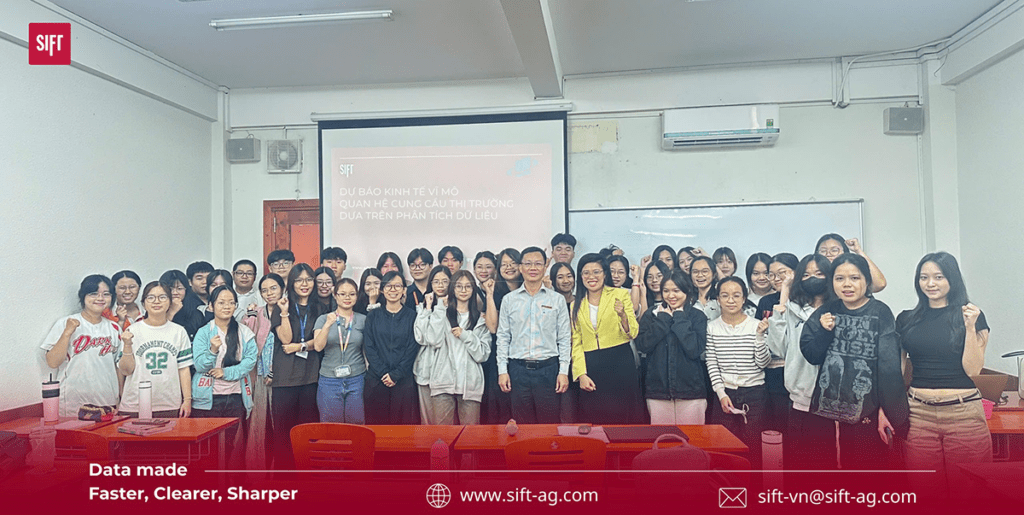
Sáng ngày 26/12, SIFT Analytics Group Vietnam đã hân hạnh đồng hành cùng Trường Đại học Mở TP.HCM trong buổi hội thảo chuyên đề “Dự báo kinh tế dựa trên phân tích dữ liệu”. Sự kiện đã thu hút sự quan tâm và thảo luận sôi nổi từ đông đảo giảng viên, sinh viên cùng các nhà nghiên cứu trong lĩnh vực kinh tế – dữ liệu.
Là một trong Top 10 nhà cung cấp giải pháp phân tích dữ liệu hàng đầu tại ASEAN , SIFT mang đến hội thảo không chỉ là kiến thức học thuật mà còn là kinh nghiệm thực chiến từ hơn 1,000 dự án đã triển khai thành công trong khu vực. Chương trình tập trung làm rõ cách ứng dụng phân tích dữ liệu định lượng và phần mềm IBM SPSS – công cụ mà SIFT hiện là đối tác 26 năm của IBM – trong quá trình xây dựng, kiểm định và diễn giải các mô hình dự báo. Thông qua đó, người học được tiếp cận phương pháp phân tích chuẩn quốc tế, giúp rút ngắn khoảng cách giữa lý thuyết và thực tiễn vận hành doanh nghiệp.
Trong khuôn khổ chương trình, chuyên gia từ SIFT đã chia sẻ các ví dụ minh họa cụ thể về vai trò của dữ liệu trong việc hoạch định chính sách và ra quyết định giữa bối cảnh kinh tế biến động. Đây cũng chính là giá trị cốt lõi mà hệ sinh thái giải pháp của SIFT bao gồm AI, Alteryx, Tableau, Qlik, AWS và Snowflake đang mang lại cho hơn 500 khách hàng doanh nghiệp lớn tại ASEAN.
Buổi hội thảo là một phần trong chiến lược Chương trình Giáo dục SIFT (SIFT Analytics Education Program). Hiện nay, SIFT tự hào là đơn vị phục vụ 100% các trường đại học tại Singapore và Thái Lan. Tại Việt Nam, SIFT đã khẳng định vị thế thông qua việc hợp tác sâu rộng với các đơn vị uy tín như: Đại học Kinh tế TP. Hồ Chí Minh (UEH) , Đại học Kinh tế – Luật (UEL) , Đại học Kinh tế Quốc dân (NEU) , Đại học Ngoại thương (FTU) , Đại học Kinh tế và Tài chính (UEF) , cùng các tổ chức nghiên cứu uy tín như Viện John von Neumann (JVN) , Đại học Quốc tế (IU) và Đại học Sư phạm Kỹ thuật TP.HCM (UTE).
Việc đồng hành cùng Trường Đại học Mở TP.HCM lần này tiếp tục minh chứng cho cam kết của SIFT trong việc kết nối tri thức học thuật với công cụ phân tích hiện đại. Với đội ngũ hơn 60 chuyên gia tư vấn đạt chứng chỉ quốc tế, SIFT Analytics Group Vietnam khẳng định sẽ tiếp tục lan tỏa tư duy dữ liệu, chuẩn hóa kỹ năng phân tích và đóng góp tích cực vào việc phát triển nguồn nhân lực chất lượng cao cho nền kinh tế số tại Việt Nam.
Khám phá những thông điệp mới nhất của chúng tôi