The Analytics Times

Enhance Data Quality and Consistency

Improving data quality is essential for making informed decisions, optimizing operational efficiency, and increasing customer satisfaction. 

How Organizations Improve Data Quality and Consistency:

In today’s digital era, businesses are awash with data. From customer transactions to social media interactions, data streams from all directions. Yet, not all data is created equal. Ensuring data quality and consistency is essential for informed decision-making and business success. Here’s a detailed guide on mastering this crucial aspect of data management.


Understanding Data Quality

Data quality is about more than just having data—it’s about having data that is accurate, complete, reliable, and relevant. High-quality data is the bedrock of meaningful analysis and insights. To ensure data quality, businesses need to focus on several key dimensions.


Accuracy is paramount. Data must accurately represent real-world values, as inaccuracies can lead to erroneous conclusions and misguided strategies. Completeness is equally critical; missing data can skew analyses and lead to incorrect insights. Reliability is another vital aspect—data should be consistent across different systems and over time, building trust in your analytics.


Lastly, relevance cannot be overlooked. Data must be pertinent to the business context, as irrelevant data can clutter systems and divert attention from critical insights.


Steps to Ensure Data Quality

The first step in ensuring data quality is data profiling and assessment. Start by profiling your data to understand its current state and assess it for accuracy, completeness, and consistency. This initial evaluation helps identify areas needing improvement.

Next is data cleansing. This involves correcting inaccuracies, filling in missing values, and removing duplicates. Implementing automated tools can streamline this process, ensuring ongoing data quality. Following cleansing, standardization is crucial. Data formats, definitions, and naming conventions should be standardized across the organization to eliminate discrepancies and ensure consistency.

Data validation is another essential step. Implementing validation rules during data entry and processing can maintain data integrity by enforcing constraints such as mandatory fields, data type restrictions, and value ranges.

To oversee these efforts, establish a data governance framework. Define roles and responsibilities for data stewardship, and create policies for data management. Governance ensures accountability and adherence to data quality standards


Maintaining Data Consistency

Consistency in data means maintaining uniformity across different systems and over time. Inconsistent data can lead to conflicting reports and hinder decision-making. Integrating data from various sources into a centralized system is crucial. Using ETL (Extract, Transform, Load) processes can harmonize data and ensure consistency during integration.


Implementing Master Data Management (MDM) is another critical step. MDM creates a single source of truth for critical business data, maintaining consistent data across the organization by synchronizing updates and resolving conflicts.


Regular audits and monitoring are also vital. Conducting regular audits can identify and rectify inconsistencies. Automated monitoring tools can detect anomalies, ensuring ongoing data integrity. Additionally, implementing version control for datasets tracks changes and maintains historical records, helping understand data evolution and resolve discrepancies.


Training and awareness play a significant role in maintaining data quality and consistency. Educating employees about the importance of data management best practices and tools fosters a culture of data stewardship across the organization.


Fostering Best Practices and Culture

Ensuring data quality and consistency is not a one-time task but an ongoing commitment. By profiling and cleansing data, standardizing processes, implementing robust validation, and maintaining strong governance, businesses can achieve high data quality. Additionally, integrating data, managing master data, conducting regular audits, and fostering a culture of data stewardship ensures consistent data.


With these practices in place, organizations can harness the power of their data to drive informed decisions, enhance operational efficiency, and gain a competitive edge in the market.


More Data-Related Topics That Might Interest You


Share

Related contents for you


Connect with SIFT Analytics

As organisations strive to meet the demands of the digital era, SIFT remains steadfast in its commitment to delivering transformative solutions. To explore digital transformation possibilities or learn more about SIFT’s pioneering work, contact the team for a complimentary consultation. Visit the website at www.sift-ag.com for additional information.

About SIFT Analytics

Get a glimpse into the future of business with SIFT Analytics, where smarter data analytics driven by smarter software solution is key. With our end-to-end solution framework backed by active intelligence, we strive towards providing clear, immediate and actionable insights for your organisation.


Headquartered in Singapore since 1999, with over 500 corporate clients, in the region, SIFT Analytics is your trusted partner in delivering reliable enterprise solutions, paired with best-of-breed technology throughout your business analytics journey. Together with our experienced teams, we will journey. Together with you to integrate and govern your data, to predict future outcomes and optimise decisions, and to achieve the next generation of efficiency and innovation.

The Analytics Times

“The Analytics Times is your source for the latest trends, insights, and breaking news in the world of data analytics. Stay informed with in-depth analysis, expert opinions, and the most up-to-date information shaping the future of analytics.

Published by SIFT Analytics

SIFT Marketing Team

marketing@sift-ag.com

+65 6295 0112

SIFT Analytics Group


The Analytics Times

Plan Your Data Integration Strategy

For a successful data integration strategy, you should clearly define the types of data integrated and who has access to them.


Plan Your Data Integration Strategy:

Businesses are generating an unprecedented amount of data. Yet, this data is often siloed across multiple platforms, making it challenging to extract actionable insights. Everyone needs a robust data integration strategy and here’s how to plan yours effectively.


If you do not want to go through this lengthy content, why not just #AskSIFT directly?


Understand Your Data Sources

First, identify all the data sources your organization relies on. This could range from CRM systems, social media analytics, ERP systems, to cloud storage services. Understanding where your data resides is the foundational step to creating a seamless integration strategy.


Define Your Objectives

What do you aim to achieve with data integration? Whether it’s enhancing customer insights, improving operational efficiency, or fostering innovation, clear objectives will guide your integration process. Setting specific goals helps in measuring the success of your strategy.


Choose the Right Tools

With numerous data integration tools available, selecting the right one can be overwhelming. Look for a tool that supports various data sources, ensures data quality, and offers real-time integration capabilities. A tool with a user-friendly interface and strong technical support can make a significant difference.


Ensure Data Quality and Consistency

Integrating data from multiple sources can lead to inconsistencies. Establish data governance protocols to maintain data quality. Implementing data validation and cleansing processes ensures that the integrated data is accurate and reliable.


Prioritize Data Security

Data security should be a top priority in your integration strategy. Ensure compliance with data protection regulations such as GDPR or CCPA. Use encryption, access controls, and regular audits to protect sensitive information from breaches.


Enable Real-Time Data Integration

In the age of instant information, real-time data integration is no longer a luxury but a necessity. Real-time integration allows businesses to respond swiftly to market changes, customer needs, and operational challenges. Choose solutions that offer real-time data synchronization to stay ahead of the curve.

Foster Collaboration

Data integration is not solely an IT initiative. It requires collaboration across departments to understand different data needs and workflows. Encourage a culture of data-sharing and cross-functional collaboration to maximize the benefits of your integrated data.


Monitor and Optimize

Once your data integration strategy is in place, continuous monitoring and optimization are essential. Regularly review the performance of your integration processes and tools. Identify areas for improvement and adapt to changing business needs to ensure long-term success.


#AskSIFT


A well-planned data integration strategy can transform your business by providing a holistic view of your operations, enhancing decision-making, and driving innovation. By understanding your data sources, defining clear objectives, choosing the right tools, ensuring data quality, prioritizing security, enabling real-time integration, fostering collaboration, and continuously optimizing, you can unlock the full potential of your data.


More Data-Related Topics That Might Interest You


Share

Related contents for you


Connect with SIFT Analytics

As organisations strive to meet the demands of the digital era, SIFT remains steadfast in its commitment to delivering transformative solutions. To explore digital transformation possibilities or learn more about SIFT’s pioneering work, contact the team for a complimentary consultation. Visit the website at www.sift-ag.com for additional information.

About SIFT Analytics

Get a glimpse into the future of business with SIFT Analytics, where smarter data analytics driven by smarter software solution is key. With our end-to-end solution framework backed by active intelligence, we strive towards providing clear, immediate and actionable insights for your organisation.


Headquartered in Singapore since 1999, with over 500 corporate clients, in the region, SIFT Analytics is your trusted partner in delivering reliable enterprise solutions, paired with best-of-breed technology throughout your business analytics journey. Together with our experienced teams, we will journey. Together with you to integrate and govern your data, to predict future outcomes and optimise decisions, and to achieve the next generation of efficiency and innovation.

The Analytics Times

“The Analytics Times is your source for the latest trends, insights, and breaking news in the world of data analytics. Stay informed with in-depth analysis, expert opinions, and the most up-to-date information shaping the future of analytics.

Published by SIFT Analytics

SIFT Marketing Team

marketing@sift-ag.com

+65 6295 0112

SIFT Analytics Group


The Analytics Times

Common Challenges in Data Analytics

The Ultimate Guide by SIFT Analytics


Common Challenges in Data Analytics:

Why do data analytics initiatives succeed, and others fail? When deploying data analytics, it comes with numerous challenges that can hinder successful implementation and achieving goals. This guide simplifies these challenges and provides insights into overcoming them. However, if you are encountering a specific challenge that is not covered here, feel free to reach out to SIFT Analytics.


Challenges in Data Literacy

Data literacy involves understanding data sources, infrastructure, analytical methods, and the ability to describe scenarios and resulting business outcomes. Improving data literacy within an organization is crucial for effective data analytics. SIFT periodically conducts data literacy workshops that you can and should request to enhance your team’s skills.


👉 Request for a Data Literacy Workshop


Challenges in Technical Knowledge and Skills

Even with powerful no-code analytics tools designed for business users, some technical knowledge and skills are necessary. These tools enable users to focus on interpreting data, refining strategies, and making informed decisions critical to the business’s success. Continuous training and upskilling are essential to keep pace with evolving tools and technologies.


Challenges in Finding the Right Analytics Tools

Choosing the right data analytics tool is challenging as no single tool fits every need. Popular analytics tools vary, and selecting the right one involves assessing many factors in line with your organization’s needs.


So, how do you identify one that’s a good fit for your company? Start by considering your organization’s business needs and knowing who will be using this analytics tool. Will it be used by data scientists, data analysts, or by non-technical users who need an intuitive interface, or should it suit both kinds of users? Some platforms provide an interactive experience for iterating on code development while others focus more on point-and-click for less technical users.


Next, what are your goals and which stage are you at in the digital transformation journey? Are you considering building real-time analytics, or do you have many incoming data through different sources where you want what we call one source of truth, ensuring data quality, governance, or migrating your data from one platform to another or automation?


You see, there are many goals. Some platforms specialize in some areas, while others can deliver seamless end-to-end implementation. So you will have to do intensive research, and the best way to start finding information is by reaching out to consultancy like SIFT Analytics to guide and provide you with proven strategies and a roadmap.


Finally, consider price and licensing. If you need advice, #AskSIFT


Challenges in Advanced Analytics

Advanced analytics, including Artificial Intelligence (AI), Machine learning (ML), Business Process Automation, Data Integration and Migration, Data Mining, and more complex analysis.


There are powerful tools to deploy advanced analytics; however, there is a need for data managers and subject matter experts, and management to be very involved to ensure that the goals are aligned and the suitable strategy.


There are a few things to take care of before evaluating the available tools. You should first understand the types of data your enterprise wants to analyze and, by extension, your data integration requirements. In addition, before you can begin analyzing data, you’ll need to select data sources and the tables and columns within them and replicate them to a data warehouse to create a single source of truth for analytics.


You’ll want to assess data security and data governance as well. If data is shared between departments, for example, there should be access control and permission systems to protect sensitive information.


Challenges in Integrating Multiple Sources

Companies often have data in various systems (e.g., CRM, Excel, social media, SAP, POS). Manually combining this data into one source can be time-consuming and error-prone.


👉 Find out more about Data Integration here


Challenges in Data Quality Issues

Maintaining high data quality is crucial. Challenges include dealing with incomplete, inconsistent, or inaccurate data. Implementing robust data quality management processes and tools is essential for reliable analytics.


Challenges in Machine Learning

Machine learning involves selecting the right algorithms, handling large datasets, and ensuring model accuracy. Continuous monitoring and updating of models are necessary to adapt to new data and maintain performance.


Challenges in Data Security and Privacy

Ensuring data security and privacy is critical, especially with increasing regulatory requirements. Implementing strong security measures and compliance protocols is essential to protect sensitive data.


#AskSIFT

Need help with any of these challenges? Reach out to SIFT Analytics for expert guidance and solutions.


More Data-Related Topics That Might Interest You


Share

Related contents for you


Connect with SIFT Analytics

As organisations strive to meet the demands of the digital era, SIFT remains steadfast in its commitment to delivering transformative solutions. To explore digital transformation possibilities or learn more about SIFT’s pioneering work, contact the team for a complimentary consultation. Visit the website at www.sift-ag.com for additional information.

About SIFT Analytics

Get a glimpse into the future of business with SIFT Analytics, where smarter data analytics driven by smarter software solution is key. With our end-to-end solution framework backed by active intelligence, we strive towards providing clear, immediate and actionable insights for your organisation.


Headquartered in Singapore since 1999, with over 500 corporate clients, in the region, SIFT Analytics is your trusted partner in delivering reliable enterprise solutions, paired with best-of-breed technology throughout your business analytics journey. Together with our experienced teams, we will journey. Together with you to integrate and govern your data, to predict future outcomes and optimise decisions, and to achieve the next generation of efficiency and innovation.

The Analytics Times

“The Analytics Times is your source for the latest trends, insights, and breaking news in the world of data analytics. Stay informed with in-depth analysis, expert opinions, and the most up-to-date information shaping the future of analytics.

Published by SIFT Analytics

SIFT Marketing Team

marketing@sift-ag.com

+65 6295 0112

SIFT Analytics Group


The Analytics Times

Difference in Data Analytics and Advanced Data Analytics

Data analytics looks at what happened. 
Advanced analytics predicts, automates and optimizes the business. 


Exploring the Difference Between Data Analytics and Advanced Data Analytics by SIFT Analytics

Ever found yourself at a crossroads trying to decide between data analytics and advanced data analytics for your business? It can be a bit daunting, but let’s break it down together. By the end, you’ll know exactly what each entails and how to make the right choice for your needs.


Introduction to Data Analytics

Think of data analytics as the first step in understanding your data. It’s all about transforming the organization’s data to extract useful info. You collect data, clean it up, transform it into a usable format, and then visualize it to spot trends and insights.


Data Analytics in Action

Picture this: a retail store wants to understand its sales performance over the past year. They collect and clean their sales data, transforming it into an easy-to-analyze format. Then, they model this data to identify trends, like which products sold the most and which months were the busiest. With these insights, they can make smart decisions, like boosting inventory for popular products during peak months.


Introduction to Advanced Data Analytics

Now, if you want to dive deeper, advanced data analytics is where things get really exciting. This involves more complex techniques and tools, like machine learning and AI, to gain even deeper insights and make more accurate predictions. Advanced analytics can even automate processes within your industry, supercharging your company’s capabilities.


Advanced Data Analytics in Action

Now, let’s say the same store wants to predict future sales and optimize their pricing strategy. They don’t just stop at sales data; they also collect customer demographics, competitor pricing, and marketing campaign data. Using machine learning algorithms, they build a predictive model that takes all these factors into account. This model can forecast future sales and suggest pricing strategies to maximize profits. The store can implement these strategies and monitor the results in real-time, with the system continuously updating the model as new data comes in.


The Role of SIFT Analytics

Here’s where SIFT Analytics comes in. We help businesses tackle the complexities of data analytics by offering both data analytics and advanced data analytics solutions. SIFT enables companies to integrate various data sources, apply modern analytics techniques, and visualize the results through powerful dashboards. This makes the analytics process simpler and helps businesses act decisively with better insights they gain.


In a nutshell..

Data analytics helps you understand past data and make informed decisions, while advanced data analytics uses sophisticated techniques such as ML and AI to get deeper insights, accurate predictions, automation, and more. By understanding the differences between these two types of analytics and seeing how they can be applied in real-world scenarios, you can better leverage your data to achieve your goals. Whether you’re looking to improve inventory management or optimize pricing strategies, the power of analytics is undeniable.


Ask SIFT

Ask SIFT  to  help you harness the power of data to steer your business in the right direction.


Implementing Data Analytics and Advanced Data Analytics


Use Case Example: Data Analytics and Advanced Data Analytics

ShopEase, a large retail company, leverages both data analytics and advanced data analytics to enhance its operations and improve customer satisfaction. By tracking past sales data across its various stores, ShopEase identifies top-selling products, seasonal trends, and customer preferences. This data-driven approach enables the company to optimize inventory and make informed decisions about future purchases.


Taking it a step further, ShopEase implements advanced data analytics, using machine learning to predict future customer buying behavior. By analyzing shopping patterns and external factors such as weather and holidays, the company can accurately forecast demand for specific products. This allows them to personalize promotions for individual customers and optimize supply chain processes to reduce waste and improve overall efficiency.


By combining these data strategies, ShopEase has successfully increased profits, minimized inventory costs, and enhanced the overall customer experience.


More Data-Related Topics That Might Interest You


Share

Related contents for you


Connect with SIFT Analytics

As organisations strive to meet the demands of the digital era, SIFT remains steadfast in its commitment to delivering transformative solutions. To explore digital transformation possibilities or learn more about SIFT’s pioneering work, contact the team for a complimentary consultation. Visit the website at www.sift-ag.com for additional information.

About SIFT Analytics

Get a glimpse into the future of business with SIFT Analytics, where smarter data analytics driven by smarter software solution is key. With our end-to-end solution framework backed by active intelligence, we strive towards providing clear, immediate and actionable insights for your organisation.


Headquartered in Singapore since 1999, with over 500 corporate clients, in the region, SIFT Analytics is your trusted partner in delivering reliable enterprise solutions, paired with best-of-breed technology throughout your business analytics journey. Together with our experienced teams, we will journey. Together with you to integrate and govern your data, to predict future outcomes and optimise decisions, and to achieve the next generation of efficiency and innovation.

The Analytics Times

“The Analytics Times is your source for the latest trends, insights, and breaking news in the world of data analytics. Stay informed with in-depth analysis, expert opinions, and the most up-to-date information shaping the future of analytics.

Published by SIFT Analytics

SIFT Marketing Team

marketing@sift-ag.com

+65 6295 0112

SIFT Analytics Group


The Analytics Times

The Cost of Ignoring Data Analytics

The Alation State of Data Culture Report, found that 97% of data leaders report their

companies have suffered the consequences of ignoring data.


Data Analytics is Not New

For decades, companies have consistently used data to track their performance, plan strategically, solve problems, eliminate assumption, and drive growth. However, in today’s fast-paced business environment, the most competitive companies are further enhancing their digital transformation efforts with advanced analytics, including predictive analysis and automation. As a result, data-driven decision-making has never been more critical. But the question remains: do you really need it, and can you afford to go without it? Ultimately, you be the judge.


The Practical Impact of Data Analytics

At SIFT Analytics, we collaborated with a well-known e-commerce company to help them gain a clearer understanding of their customers and, in turn, fine-tune their marketing strategies. By bringing together data from various sources—such as CRM systems, Google Analytics, social media, and websites—wherever the customer had interactions, we created a comprehensive view. After successfully integrating this data, we utilized advanced analytics and AI to provide predictive insights, track marketing performance, and identify emerging trends. In today’s competitive market, having the right insights truly makes all the difference.


This strategic approach empowered the e-commerce business to focus on what matters most: their customers. Armed with these valuable insights, they were able to refine their marketing strategies and significantly enhance the customer experience with content tailored specifically to their audience. Furthermore, AI played a crucial role in helping them determine which content to emphasize and which segments to target. The outcome? More engaged customers spending more time on their site, leading to a noticeable increase in sales.


Practically Speaking

Without data, decisions often rely on gut feelings, past experiences, or risky guesses—ultimately leading to poor outcomes. For instance, take pricing decisions: how much should you adjust your prices to attract more customers? You could make an assumption, or alternatively, you could use data to make a statistically backed decision.


Similarly, consider an HR department in healthcare dealing with high employee turnover. Rather than guessing why people are leaving, data can instead provide insights into staffing shortages, employee satisfaction, performance, and demographic trends. Moreover, making assumptions, especially when managing human resources, can result in even more significant problems. Therefore, having the right data is crucial for making informed decisions that effectively address employee needs.


The Actual Cost of Ignoring Data Analytics

Simply put, ignoring data risks your business’s potential to compete effectively. By doing so, you’re taking huge risks and are likely missing out on significant opportunities. Specifically, data reveals where your market is heading, how efficient your operations are, whether your employees are performing optimally, and identifies new opportunities within the market.


Furthermore, steering your business in the right direction becomes increasingly challenging when everyone has different opinions and ideas on how to resolve issues. In contrast, analytics aligns your team, clearly communicates value, and ultimately helps plan strategically.


Ask SIFT

Ask SIFT  to  help you harness the power of data to steer your business in the right direction.


Missing Opportunities for Retail Case


Consider this: data can reveal trends, customer preferences, and market opportunities that you might otherwise overlook. Without these critical insights, you risk missing the chance to enter new markets or pivot your strategies at the opportune moment. It’s akin to possessing a treasure map but choosing not to use it.


For instance, a retail company aiming to expand its product line might rely solely on historical sales data and intuition. This approach could lead them to invest heavily in a product that underperforms. Meanwhile, their competitors, leveraging data-driven insights, identify a growing trend in eco-friendly products. Consequently, they capture market share by launching a successful line of sustainable goods. The retail company misses this opportunity simply because they did not utilize data to anticipate the trend.


Poor Decision-Making for Manufacturing Case


Frequently, decisions made without data rely on gut feelings, past experiences, or merely taking a shot in the dark. This can lead to poor choices that negatively impact your finances, cause missed opportunities, and even damage your reputation. On the other hand, embracing data analytics provides solid insights and evidence that guide you toward better, more informed decisions.


For example, a CEO of a mid-sized manufacturing company might decide to enter a new market based on the assumption that their current product will appeal to a different demographic. Without conducting a thorough data analysis, the company misjudges market demand and invests heavily in marketing and production. As a result, sales fall significantly below expectations, leading to substantial financial losses and a damaged brand reputation. Had they used data analytics to assess market needs and preferences, a more informed decision could have been made.


Inefficient Operations for Logistic Case


Data analytics can pinpoint inefficiencies within your operations and suggest areas for improvement. Without it, you might continuously encounter the same problems, resulting in wasted time, resources, and money. These inefficiencies accumulate, leading to higher costs and reduced profits.


For instance, a logistics company might assume their delivery routes are optimized. However, without data analytics, they fail to recognize several inefficient routes, resulting in higher fuel costs, extended delivery times, and frustrated customers. By the time they identify the issue through customer complaints, they have already lost business to a competitor who used data analytics to streamline operations and reduce delivery times by 15%.


Inability to Compete for Retail Case


In today’s highly competitive market, having a deep understanding of your industry and customers is essential to staying ahead. Ignoring data analytics places you at risk of falling behind more agile and informed competitors. Utilizing data analytics provides valuable insights, helps you adapt swiftly to market changes, and maintains your competitive edge.


For example, a traditional bookstore chain struggling to compete with online retailers might disregard data analytics and stick to their existing business model, assuming their loyal customer base will suffice. Meanwhile, a competitor harnesses data to understand customer preferences, optimize inventory, and create a personalized online shopping experience. As a result, the competitor quickly gains market share, while the bookstore chain experiences declining sales, eventually leading to store closures. By failing to adopt data-driven strategies, the bookstore chain loses its competitive edge and market position.


More Data-Related Topics That Might Interest You


Share

Related contents for you


Connect with SIFT Analytics

As organisations strive to meet the demands of the digital era, SIFT remains steadfast in its commitment to delivering transformative solutions. To explore digital transformation possibilities or learn more about SIFT’s pioneering work, contact the team for a complimentary consultation. Visit the website at www.sift-ag.com for additional information.

About SIFT Analytics

Get a glimpse into the future of business with SIFT Analytics, where smarter data analytics driven by smarter software solution is key. With our end-to-end solution framework backed by active intelligence, we strive towards providing clear, immediate and actionable insights for your organisation.


Headquartered in Singapore since 1999, with over 500 corporate clients, in the region, SIFT Analytics is your trusted partner in delivering reliable enterprise solutions, paired with best-of-breed technology throughout your business analytics journey. Together with our experienced teams, we will journey. Together with you to integrate and govern your data, to predict future outcomes and optimise decisions, and to achieve the next generation of efficiency and innovation.

The Analytics Times

“The Analytics Times is your source for the latest trends, insights, and breaking news in the world of data analytics. Stay informed with in-depth analysis, expert opinions, and the most up-to-date information shaping the future of analytics.

Published by SIFT Analytics

SIFT Marketing Team

marketing@sift-ag.com

+65 6295 0112

SIFT Analytics Group


Make a Difference with Data Analytics in the Social Service Sector

Social Service Agencies (SSAs) often face challenges related to resource limitation and operational issues. Discover how data analytics can transform the social service sector across eight key areas, from optimizing fundraising efforts to enhancing patient care and facility management. 


SIFT Analytics Group has collaborated with various SSAs to implement data analytics in a way that users doesn’t require technical expertise. This approach enables organizations to gain better insights into their operations, helping them create a more responsive and effective social service system.

Social_Services_Donations

Donations

Understand donor behavior, preferences, and trends to optimize fundraising efforts.

By analyzing donor demographics, patterns, and communication channels, organizations can tailor their campaigns for maximum impact.


Example: Analytics can identify segments of donors who are more likely to respond to specific appeals, allowing organizations to personalize their outreach strategies and increase donation conversion rates.

Social_Services_Nursing_Home

Nursing Home

Analyze patient data, staffing levels, and facility usage patterns.


By leveraging data analytics tools, nursing homes can optimize staffing schedules, anticipate patient needs, and enhance overall quality of care. 


Example: Analytics can identify trends in patient health outcomes and medication usage, enabling nursing homes to adjust their care plans accordingly and improve overall resident satisfaction and well-being.

Social_Services_Facilities

Facilities

Track maintenance needs, resource utilization, and facility usage patterns.


By monitoring data such as equipment performance, energy consumption, and space utilization, organizations can identify opportunities for cost savings and efficiency improvements. 


Example: Analytics can help facilities identify maintenance issues,  optimize energy usage to reduce costs, and allocate space more efficiently to meet high demand and maximize utilization rates.

Social_Services_Rehab

Rehab

Analyze patient progress, treatment effectiveness, and therapy outcomes.

By tracking patient data such as rehabilitation exercises, mobility levels, and recovery milestones, rehab centers can personalize treatment plans and monitor progress more effectively.


Example:  Analytics can help identify correlations between specific therapy interventions and patient outcomes, enabling rehab centers to tailor treatment protocols for individual patients and optimize rehabilitation strategies for better recovery results.

Social_Services_Finance

Finance

Gain insights into financial performance, budget allocation, and cost optimization.

By analyzing financial data such as revenue streams, expenses, and cash flow patterns, organizations can identify areas for improvement and make informed decisions. 


Example: Analytics can highlight areas of overspending or inefficiency, enabling organizations to reallocate resources effectively and streamline financial processes for better fiscal management.

Social_Services_Operations

Operations

Identify bottlenecks, improving resource utilization, and enhancing overall efficiency.

By analyzing operational data such as workflow patterns, resource allocation, and performance metrics, organizations can identify areas for process optimization and implement targeted improvements.


Example: Analytics can help identify inefficiencies in workflow processes, enabling organizations to streamline operations, reduce costs, and improve service delivery.

Social_Services_Daycare

Daycare

Optimize enrollment, scheduling, and staff allocation.


By analyzing attendance patterns, caregiver-to-child ratios, and parent feedback, daycares can improve operational efficiency and provide better care for children.


Example: Analytics can help daycare centers forecast demand for childcare services, allocate staff resources more effectively, and optimize scheduling to accommodate fluctuating enrollment levels and maintain high-quality care standards.

Social_Services_Social_Media

Social Media

Measure the effectiveness of social media efforts and engage with their target audience more strategically.

By analyzing social media metrics such as engagement rates, audience demographics, and content performance, organizations can refine their social media strategies to drive meaningful interactions and achieve their objectives.


Example: Analytics can identify the types of content that resonate most with followers, helping organizations create more engaging posts and increase their social media presence.

SIFT_Analytics

#AskSIFT

Learn more with SIFT Analytics.

Whether you have questions, need advice, or are looking for solutions to specific challenges in your organization, we’re ready to listen and offer guidance tailored to your needs.


Connect with SIFT Analytics

As organisations strive to meet the demands of the digital era, SIFT remains steadfast in its commitment to delivering transformative solutions. To explore digital transformation possibilities or learn more about SIFT’s pioneering work, contact the team for a complimentary consultation. Visit the website at www.sift-ag.com for additional information.

About SIFT Analytics

Get a glimpse into the future of business with SIFT Analytics, where smarter data analytics driven by smarter software solution is key. With our end-to-end solution framework backed by active intelligence, we strive towards providing clear, immediate and actionable insights for your organisation.


Headquartered in Singapore since 1999, with over 500 corporate clients, in the region, SIFT Analytics is your trusted partner in delivering reliable enterprise solutions, paired with best-of-breed technology throughout your business analytics journey. Together with our experienced teams, we will journey. Together with you to integrate and govern your data, to predict future outcomes and optimise decisions, and to achieve the next generation of efficiency and innovation.

Published by SIFT Analytics

SIFT Marketing Team

marketing@sift-ag.com

+65 6295 0112

SIFT Analytics Group


Employee Experience Is the Key to Better Customer Experience

Imagine what happens when someone who is passionate about their work and your company frequently runs into issues with their hardware or software. It leads to a bad experience and they eventually lose interest in their work and your organization. This results in poor employee experience that leads to higher attrition rates and occasionally a poor customer experience.


The success of an organization is not just dependent on the product or service they sell but is also based on the people who are part of it. Processes that stand in their way or slows them down hurts the employee experience.

In this eBook, you’ll know:
 
  • What is employee experience?
  • What are the benefits of employee experience?
  • How it affects your business? and
  • How you can transform your company’s customer experience by creating a better employee experience

Download eBook

    SIFT Analytics will only use your personal information to provide the product or service you requested and contact you with related content that may interest you. You may unsubscribe from these communications at any time. View Privacy Policy

    Connect with SIFT Analytics

    As organisations strive to meet the demands of the digital era, SIFT remains steadfast in its commitment to delivering transformative solutions. To explore digital transformation possibilities or learn more about SIFT’s pioneering work, contact the team for a complimentary consultation. Visit the website at www.sift-ag.com for additional information.

    About SIFT Analytics

    Get a glimpse into the future of business with SIFT Analytics, where smarter data analytics driven by smarter software solution is key. With our end-to-end solution framework backed by active intelligence, we strive towards providing clear, immediate and actionable insights for your organisation.


    Headquartered in Singapore since 1999, with over 500 corporate clients, in the region, SIFT Analytics is your trusted partner in delivering reliable enterprise solutions, paired with best-of-breed technology throughout your business analytics journey. Together with our experienced teams, we will journey. Together with you to integrate and govern your data, to predict future outcomes and optimise decisions, and to achieve the next generation of efficiency and innovation.

    Published by SIFT Analytics

    SIFT Marketing Team

    marketing@sift-ag.com

    +65 6295 0112

    SIFT Analytics Group


    Data Trends 2024

    Anticipated to influence the legal terrain of data, here are six trends in 2024 that are likely to shape the landscape in the years ahead.

    1

    Advancing Adoption of AI


    The previous year witnessed the widespread embrace of generative artificial intelligence (AI), presenting governments and organizations with intricate dilemmas on adapting to AI’s challenges and opportunities. Many enterprises possess extensive data repositories, prompting the exploration of additional value and efficiencies through AI.

    2

    Increasing Complexity and Global Alignment of Privacy Regulations

    The year 2023 marked the continual expansion of privacy regulations globally, with an increasing number of countries adopting comprehensive privacy laws. While each jurisdiction maintains its unique approach to privacy regulation, common elements are emerging across these laws.

    3

    Businesses Respond to a Shifting Cyber Risk Landscape

    Businesses are facing heightened awareness regarding two significant risks – ransomware and insider threats. To tackle these emerging challenges, companies will require actionable insights to significantly enhance their ability to respond to future incidents.

    4

    The strengthening of
    Data Portability rights

    There is growing empowerment for companies to seamlessly move and transfer their data between platforms, fostering increased control and flexibility over their digital information. This evolution reflects a heightened emphasis on user-centric data management, promoting privacy and data autonomy in the digital landscape.

    5

    Rising Threat of Data Litigation


    High-profile and extensive data breaches have always posed the risk of expensive and reputationally damaging mass litigation, and such claims persist. Data breaches and evolving case law and legislation are some of these recent trends indicating that data litigation should remain a primary concern for numerous organizations.

    6

    Businesses Globally Prioritize Acquiring Valuable Datasets

    Persistent issues related to data, such as data ownership and data protection, will continue to be crucial in mergers and acquisitions (M&A). Moreover, new challenges have risen, such as when buyers seek to acquire artificial intelligence (AI) related assets, or when developments in international data transfers require consideration.

    Connect with SIFT Analytics

    As organisations strive to meet the demands of the digital era, SIFT remains steadfast in its commitment to delivering transformative solutions. To explore digital transformation possibilities or learn more about SIFT’s pioneering work, contact the team for a complimentary consultation. Visit the website at www.sift-ag.com for additional information.

    About SIFT Analytics

    Get a glimpse into the future of business with SIFT Analytics, where smarter data analytics driven by smarter software solution is key. With our end-to-end solution framework backed by active intelligence, we strive towards providing clear, immediate and actionable insights for your organisation.


    Headquartered in Singapore since 1999, with over 500 corporate clients, in the region, SIFT Analytics is your trusted partner in delivering reliable enterprise solutions, paired with best-of-breed technology throughout your business analytics journey. Together with our experienced teams, we will journey. Together with you to integrate and govern your data, to predict future outcomes and optimise decisions, and to achieve the next generation of efficiency and innovation.

    Published by SIFT Analytics

    SIFT Marketing Team

    marketing@sift-ag.com

    +65 6295 0112

    SIFT Analytics Group


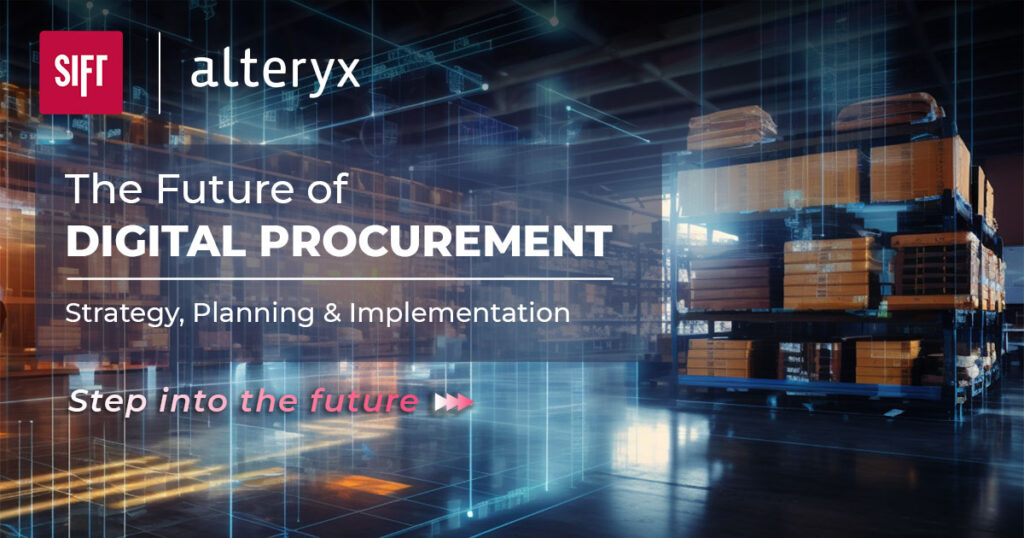
    The Future of DIGITAL PROCUREMENT

    Strategy, Planning & Implementation

    Optimize your supply chain planning and effectively tackle procurement challenges.

    Companies insisting on sticking to outdated procurement methods, which lack data-driven insights and visibility in their supply chain, have a higher risk of overspending and operating an ineffective supply chain.


    Discover how the Alteryx Procurement Analytics solution can assist your organization in enhancing procurement process visibility, reducing spending, and mitigating risks in the supply chain.

    Procurement Challenges

    Measuring Procurement Contribution

    Assessing the impact of procurement on the bottom line and overall profitability is a challenge.

    Cost of Goods Sold Control

    Controlling raw material costs is crucial, involving factors such as timing, product quality, and supplier relationships.

    Tool Limitations

    Procurement managers face limitations with tools like spreadsheets and spend-analysis software, struggling to extract valuable insights from relevant data sources.

    Alteryx Procurement Analytics Solutions

    Expanded Analytical Scope

    Enable procurement managers to move beyond traditional spend analysis, encompassing areas like cost modeling, supplier risk/performance, and market intelligence.

    Comprehensive Data Integration

    By collecting data from diverse sources, procurement managers create a holistic view of material procurement, aiding in cost control and supply chain risk mitigation.

    Long-Term Value

    Identify cost-saving opportunities, opening new markets, and optimizing supply chain processes through predictive analytics tools.

    Benefits At a Glance

    Efficiency Gains

    Assess vendor quality and maximize your spend.

    Customer Experience

    Ensure end product meets demand and serves customers’ needs.

    Risk Reduction

    Make confident procurement decisions to minimize costs while meeting demand in a constantly disrupted supply chain.

    Connect with SIFT Analytics

    As organisations strive to meet the demands of the digital era, SIFT remains steadfast in its commitment to delivering transformative solutions. To explore digital transformation possibilities or learn more about SIFT’s pioneering work, contact the team for a complimentary consultation. Visit the website at www.sift-ag.com for additional information.

    About SIFT Analytics

    Get a glimpse into the future of business with SIFT Analytics, where smarter data analytics driven by smarter software solution is key. With our end-to-end solution framework backed by active intelligence, we strive towards providing clear, immediate and actionable insights for your organisation.


    Headquartered in Singapore since 1999, with over 500 corporate clients, in the region, SIFT Analytics is your trusted partner in delivering reliable enterprise solutions, paired with best-of-breed technology throughout your business analytics journey. Together with our experienced teams, we will journey. Together with you to integrate and govern your data, to predict future outcomes and optimise decisions, and to achieve the next generation of efficiency and innovation.

    Published by SIFT Analytics

    SIFT Marketing Team

    marketing@sift-ag.com

    +65 6295 0112

    SIFT Analytics Group


    SIFT Analytics Unveils Data Trends, Challenges, Opportunities, and Future Outlook

    DATA TRENDS

    Data Explosion

    Digital platforms and social media have led to exponential data growth, offering vast opportunities for data-driven decision-making.

    Advanced Techniques

    Predictive analytics, prescriptive analytics, and machine learning have revolutionized Data Analytics, providing deeper insights and optimized processes.

    AI Integration

    Artificial Intelligence and machine learning enhance automated data analysis and real-time decision-making, boosting efficiency.

    Real-Time Analytics

    Businesses are adopting real-time solutions for prompt decision-making, addressing critical events as they unfold.

    Data Privacy and Ethics

    Compliance with regulations like GDPR is vital. Ethical considerations, transparency, and bias are essential factors in data usage.

    CHALLENGES

    Data Quality

    Ensuring accurate and integrated data from diverse sources remains a challenge, necessitating robust governance strategies.

    Skill Gap

    Demand for skilled data analysts outstrips supply, requiring expertise in statistics, programming, machine learning, and domain knowledge.

    OPPORTUNITIES

    Process Optimization

    Data Analytics streamlines workflows, identifies bottlenecks, and boosts productivity, enhancing operational efficiency.

    Customer Insights

    Understanding customer behavior enables targeted marketing, personalized experiences, and improved satisfaction.

    Key Players

    Major industry players like AWS and IBM offer comprehensive solutions. Firms such as SIFT provide consulting and offer end-to-end data analytics tools.

    FUTURE OUTLOOK

    Industry Forecast

    According to the Business Leaders review, the global Data Analytics market is set to reach $132.9 billion by 2026, driven by AI adoption, IoT, and real-time analytics, growing at a CAGR of 28.9%.

    Impact of Developments

    Privacy Regulations — Evolving laws influence data practices, emphasizing compliance and responsible data usage.

    AI Advancements — AI integration enhances data processing and predictive capabilities, fostering innovation.

    Ethical Focus — Heightened awareness may lead to frameworks addressing biases and ensuring transparency in Data Analytics practices.

    In a nutshell, Data Analytics experiences unprecedented growth due to advanced techniques and AI integration. Challenges in data quality and skills are met with opportunities in process optimization and enriched customer insights. Future advancements will be guided by evolving regulations and ethical considerations, steering the industry toward innovation and responsible practices.

    Connect with SIFT Analytics

    As organisations strive to meet the demands of the digital era, SIFT remains steadfast in its commitment to delivering transformative solutions. To explore digital transformation possibilities or learn more about SIFT’s pioneering work, contact the team for a complimentary consultation. Visit the website at www.sift-ag.com for additional information.

    About SIFT Analytics

    Get a glimpse into the future of business with SIFT Analytics, where smarter data analytics driven by smarter software solution is key. With our end-to-end solution framework backed by active intelligence, we strive towards providing clear, immediate and actionable insights for your organisation.


    Headquartered in Singapore since 1999, with over 500 corporate clients, in the region, SIFT Analytics is your trusted partner in delivering reliable enterprise solutions, paired with best-of-breed technology throughout your business analytics journey. Together with our experienced teams, we will journey. Together with you to integrate and govern your data, to predict future outcomes and optimise decisions, and to achieve the next generation of efficiency and innovation.

    Published by SIFT Analytics

    SIFT Marketing Team

    marketing@sift-ag.com

    +65 6295 0112

    SIFT Analytics Group