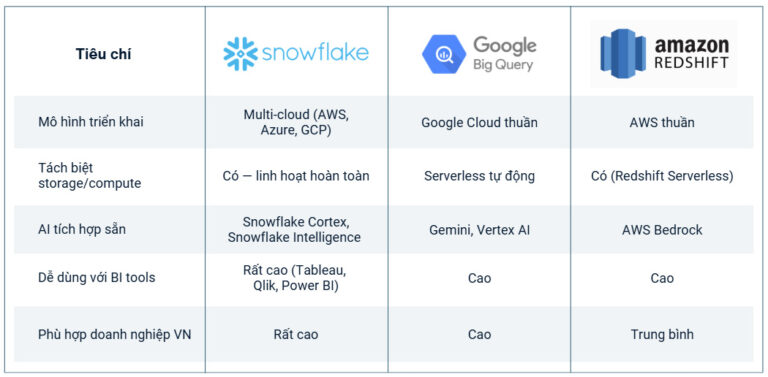
Snowflake đang được hàng nghìn doanh nghiệp toàn cầu lựa chọn làm nền tảng Data Cloud trung tâm. Nhưng để triển khai Snowflake đúng cách – tối ưu chi phí, bảo mật dữ liệu và tích hợp mượt với hệ thống hiện có – bạn cần một đối tác có chuyên môn sâu.
SIFT Analytics Group là Snowflake Trusted Partner được chứng nhận tại Đông Nam Á, với hàng chục dự án triển khai thực tế tại Singapore, Thái Lan, Philippines và nay là Việt Nam.
Nhiều IT Manager tại Việt Nam đang đối mặt với cùng một vấn đề: dữ liệu nằm rải rác ở nhiều hệ thống – ERP, CRM, phần mềm kế toán, sàn thương mại điện tử – không thể kết hợp để phân tích tổng thể. Snowflake giải quyết điều đó bằng kiến trúc Data Cloud cho phép:
SIFT không chỉ cài đặt và bàn giao. Đội ngũ kỹ sư dữ liệu của SIFT sẽ:
Các tập đoàn tài chính, công ty bảo hiểm, hãng logistics lớn và nền tảng thương mại điện tử hàng đầu trong khu vực đã tin dùng Snowflake. Với chi phí vận hành theo mô hình pay-per-use, Snowflake phù hợp cả với công ty đang ở giai đoạn mở rộng dữ liệu lẫn enterprise đã có khối lượng dữ liệu lớn.
Việc xây dựng một hệ thống Data Cloud không chỉ là câu chuyện về công nghệ, mà là về cách bạn kiểm soát chi phí và bảo mật dữ liệu lâu dài. Với tư cách là Snowflake Trusted Partner, SIFT Analytics cam kết giúp doanh nghiệp Việt rút ngắn thời gian triển khai và tối đa hóa hiệu suất đầu tư.
Khám phá những thông điệp mới nhất của chúng tôi
“Chúng tôi cần real-time analytics” – đây là một trong những câu SIFT hay nghe nhất khi tư vấn cho doanh nghiệp mới. Và đây cũng là nơi chúng tôi thường phải đặt câu hỏi ngược lại: “Thực sự cần real-time, hay near-real-time là đủ?”
Sự phân biệt này có thể quyết định hàng tỷ đồng chi phí hạ tầng.
Batch Analytics (Phân tích theo lô): Dữ liệu được xử lý theo lịch cố định – hàng giờ, hàng ngày, hàng tuần. Chi phí thấp nhất, đơn giản nhất. Phù hợp với: báo cáo tài chính tháng, phân tích xu hướng, KPI định kỳ.
Near-Real-Time Analytics (Gần thời gian thực): Dữ liệu được cập nhật trong vòng vài phút đến 15–30 phút. Đủ nhanh cho hầu hết use case doanh nghiệp. Phù hợp với: dashboard vận hành, theo dõi doanh số trong ngày, cảnh báo tồn kho.
Real-Time Streaming Analytics (Thời gian thực hoàn toàn): Dữ liệu được xử lý trong milliseconds đến vài giây. Chi phí cao nhất, phức tạp nhất. Chỉ thực sự cần thiết khi: phát hiện gian lận giao dịch, hệ thống trading tần suất cao, giám sát an ninh mạng, điều khiển thiết bị IoT theo thời gian thực.
Cần real-time thực sự (milliseconds):
Near-real-time là đủ (vài phút):
Batch là đủ (hàng giờ/ngày):
Truyền thống, để có streaming analytics, doanh nghiệp cần Apache Kafka + Flink/Spark Streaming – phức tạp, tốn kém và cần đội ngũ kỹ thuật chuyên sâu.
Snowflake Dynamic Tables và Snowflake Intelligence (tính năng mới) cho phép dữ liệu tự động cập nhật trong warehouse với độ trễ chỉ vài phút – mà không cần hạ tầng streaming phức tạp. Đây là điểm quan trọng: hầu hết doanh nghiệp Việt Nam có thể đạt được “đủ nhanh” với Snowflake mà không cần đầu tư vào Kafka stack. Với BOD, CEO chỉ cần hỏi đáp bằng ngôn ngữ tự nhiên, Snowflake Intelligence sẽ trả về số liệu, biểu đồ kèm các insights để ra quyết định. Đây là bước đột phá mới nhất trong công nghệ hiện nay. Không cần team Data và IT lớn, không cần chờ hàng tuần, hàng này để lấy báo cáo không có insights. Điều cần làm là tạo datawarehouse, mang AI vào dữ liệu của doanh nghiệp và chiến.
SIFT Analytics tư vấn kiến trúc analytics phù hợp – tránh đầu tư thừa vào real-time khi near-real-time là đủ, và đảm bảo real-time khi thực sự cần.
Đăng ký tư vấn Snowflake cùng SIFT Analytics Vietnam ngay hôm nay.
Khám phá những thông điệp mới nhất của chúng tôi
IBM phát hành SPSS Statistics 32 vào tháng 4/2026 với ba trọng tâm: thêm các phương pháp thống kê nâng cao, giúp việc đọc và trình bày kết quả dễ hơn, và cho quản trị viên nhiều quyền kiểm soát hơn. Với giảng viên, nghiên cứu sinh và sinh viên, điểm đáng chú ý là nhiều phân tích trước đây phải dùng macro hoặc phần mềm ngoài nay đã làm được ngay trong SPSS. Bài viết cũng điểm lại các tính năng đáng chú ý từ bản 29 đến 31 dành cho những trường chưa nâng cấp. Bản Campus Edition sẽ là bản Premium bao gồm tất cả các tính năng mới trên bản SPSS 32.
Tính năng này hỗ trợ đọc, diễn giải và giải thích kết quả thống kê bằng ngôn ngữ tự nhiên thay vì chỉ hiển thị các chỉ số phức tạp như p-value, F-statistic hay hệ số hồi quy. Người dùng có thể hiểu nhanh ý nghĩa của dữ liệu, xác định giả thuyết và truyền đạt kết quả nghiên cứu trực quan hơn. Đặc biệt phù hợp với Sinh viên, Giảng viên, Tâm lý học, Giáo dục, Quản trị kinh doanh và các ngành không chuyên sâu thống kê vì giúp giảm rào cản khi tiếp cận phân tích dữ liệu. “Sinh viên có thể hiểu ngay “Chất lượng dịch vụ ảnh hưởng tích cực đến mức độ hài lòng khách hàng” mà không cần tự diễn giải toàn bộ bảng số liệu”.
VAR cho phép phân tích cùng lúc nhiều chuỗi thời gian có ảnh hưởng qua lại, trong đó mỗi biến được mô hình hóa theo giá trị quá khứ của chính nó và của các biến còn lại. Ví dụ điển hình là mối quan hệ giữa tăng trưởng GDP, lạm phát và lãi suất, hoặc giữa doanh số, chi phí quảng cáo và mức độ hài lòng của khách hàng. Mô hình này hữu ích cho nghiên cứu kinh tế, tài chính – ngân hàng và phân tích thị trường.
Số liệu mẫu chạy test cho các campaign sales áo quần giữa Nam/Nữ/trang sức:
SPSS giờ nhập trực tiếp được file .fastq và .fq, chuyển thành dataset để phân tích mà không cần công cụ chuyển đổi trung gian. Các file lớn được xử lý nền dưới dạng job: bạn có thể theo dõi hoặc hủy job và vẫn chạy các thủ tục khác trong lúc chờ. Sau đó có thể áp dụng thống kê mô tả, tương quan, hồi quy cho các chỉ số bộ gen, phù hợp với nghiên cứu y sinh và dược học.
Tính năng này cho phép bạn tự viết phần giải thích và tô màu ô trong bảng kết quả theo khoảng giá trị. Ví dụ, ô Sig. nhỏ hơn 0,05 hiện một màu kèm câu diễn giải, còn ô lớn hơn 0,05 hiện màu khác. Khác với Curated Help có sẵn, vốn chỉ áp dụng cho một số thủ tục, Designer dùng được với bất kỳ bảng nào có chiều thống kê. Giảng viên có thể soạn một lần rồi chia sẻ file cho sinh viên hoặc đồng nghiệp, hoặc sao lưu để dùng lại.
Bản 32 bổ sung 4 tính năng qua Extension Hub.
Permutation Test (STATS PERM) thực hiện kiểm định hoán vị cho t-test hai nhóm, ANOVA và hồi quy mà không đòi hỏi phân phối chuẩn, phù hợp với mẫu nhỏ.
Tiêu đề mặc định của biểu đồ trong Chart Builder được rút gọn, bớt lặp lại tên loại biểu đồ.
Ở bản 32, quản trị viên có thể tắt hoàn toàn AI Output Assistant (tính năng ra mắt từ bản 31.0.1, xem phần dưới), phù hợp với những trường có quy định riêng về sử dụng AI hoặc quản trị dữ liệu. Ngoài ra, SPSS Statistics Digital hỗ trợ đăng nhập bằng passkey (vân tay, mã PIN hoặc khóa bảo mật) thay cho mật khẩu.
Nếu đang dùng bản 28 trở xuống hoặc chưa cập nhật từ bản 29, dưới đây là các tính năng đáng chú ý IBM đã bổ sung qua từng phiên bản.
Bản 29 đưa vào các thủ tục hồi quy có điều chuẩn dạng extension gồm Elastic Net, Lasso và Ridge, hữu ích khi mô hình có nhiều biến độc lập tương quan với nhau. Bản này cũng có mô hình sống sót tham số SURVREG AFT, thủ tục MIXED bổ sung pseudo-R² và hệ số tương quan nội lớp (ICC), và biểu đồ violin trong Graphboard. Python 3.10.4 và R 4.2.0 được cài sẵn kèm theo.
Bản 29.0.1 bổ sung tab Overview, cho thấy ngay khi mở file dữ liệu số biến, số quan sát, kiểu biến và tình trạng giá trị thiếu, kèm biểu đồ từng biến. Hộp thoại Percentiles mới cho chọn phân vị tùy ý, một trong năm phương pháp ước lượng và khoảng tin cậy bootstrap. Ngoài ra còn có chỉ số Youden cho đường cong ROC, thống kê PRESS trong hồi quy tuyến tính, và các lối tắt chuột phải trong bảng kết quả như hoán đổi hàng cột, sắp xếp, ẩn cột.
Cập nhật Bland-Altman Analysis trong nhóm Descriptive Statistics, dùng để đánh giá mức độ đồng thuận giữa hai phương pháp đo, rất hữu ích với nghiên cứu y khoa.
Analyze > Descriptive Statistics > Bland Altman Analysis.
Normality Analysis (extension) gom các kiểm định và biểu đồ về phân phối chuẩn vào một hộp thoại. Về giao diện, SPSS 30 có Dark Mode, tùy chọn Text scaling cho màn hình 4K trên Windows, thanh trạng thái và biểu tượng thanh công cụ được thiết kế lại, thời gian khởi động nhanh hơn, và R được nâng lên bản 4.4.1.
Bản 31 mở rộng bộ công cụ phân tích với Proximity Mapping (Analyze > Mapping), trực quan hóa quan hệ giữa các đối tượng như thương hiệu hay nhóm xã hội trên bản đồ 2–3 chiều. |
Distance Correlation phát hiện cả quan hệ phi tuyến mà không đòi hỏi phân phối chuẩn, với hệ số từ 0 đến 1 và giá trị 0 nghĩa là hai biến độc lập. Ba extension mới là Conditional Inference Tree, STATS EARTH (hồi quy MARS bắt các quan hệ phi tuyến và tương tác) và Time Series Filters. Chúng được cài từ Extension Hub, hai extension đầu cần R.
Để sở hữu chuẩn hoá SPSS 32 trong nghiên cứu giảng dạy, liên hệ SIFT Analytics là đối tác uỷ quyền của IBM 26 năm, đạt chứng nhận IBM Premium Business Partner, IBM Software Practice Accreditation và nhiều giải thưởng liên từ IBM SPSS tại khu vực châu Á – Thái Bình Dương.
Liên hệ SIFT Việt Nam về SPSS SPSS Campus Edition:
Trao đổi trực tiếp cùng chuyên gia
Khám phá những thông điệp mới nhất của chúng tôi
SIFT Analytics là đơn vị cung cấp phần mềm bản quyền IBM SPSS Campus Edition cho khối giáo dục, hỗ trợ các trường đại học, cao đẳng và viện đào tạo triển khai phần mềm thống kê bản quyền trong giảng dạy, nghiên cứu khoa học và phân tích dữ liệu thực tế.
Theo SIFT Analytics, IBM SPSS Campus Edition là nền tảng được xây dựng cho giáo dục đại học, đủ mạnh cho nghiên cứu nhưng vẫn đủ dễ dùng để sinh viên có thể tiếp cận. SIFT cũng cho biết giải pháp này đã được hơn 400 trường đại học tại Đông Nam Á sử dụng, cho thấy mức độ phổ biến của SPSS trong môi trường học thuật.
Không chỉ cung cấp phần mềm, SIFT còn hỗ trợ nhà trường trong quá trình tư vấn bản quyền, lựa chọn gói phù hợp, triển khai cho phòng máy, giảng viên, sinh viên hoặc học viên cao học. Bên cạnh đó, SIFT có thể đồng hành trong hoạt động training, giúp người dùng biết cách nhập dữ liệu khảo sát, xử lý dữ liệu, chạy thống kê và ứng dụng kết quả vào nghiên cứu.
Một điểm giúp SIFT Analytics tăng độ tin cậy là hệ thống chứng nhận và giải thưởng liên quan đến IBM. Trang Awards and Accolades của SIFT liệt kê nhiều chứng nhận như IBM Premium Business Partner, IBM Software Practice Accreditation, First IBM SPSS Software Practice Gold Accreditation in Asia Pacific và IBM SPSS Franchise of the Year APAC.
Với các trường đại học và cao đẳng, việc lựa chọn một đơn vị có kinh nghiệm triển khai trong khu vực sẽ giúp quá trình mua bản quyền, cài đặt, đào tạo và sử dụng phần mềm thuận lợi hơn. Điều này đặc biệt quan trọng khi SPSS được dùng trong phòng lab, lớp học, khóa luận, luận văn cao học và các đề tài nghiên cứu khoa học.
SIFT Analytics Vietnam cũng đã có nhiều hoạt động kết nối với khối giáo dục tại Việt Nam. Chẳng hạn, SIFT từng đồng hành cùng Trường Đại học Mở TP.HCM trong hội thảo “Dự báo kinh tế dựa trên phân tích dữ liệu”. Chương trình tập trung làm rõ cách ứng dụng phân tích dữ liệu định lượng và phần mềm IBM SPSS trong quá trình xây dựng, kiểm định và diễn giải các mô hình dự báo.
Ngoài ra, SIFT cũng có các hoạt động như workshop “Kỹ năng phân tích dữ liệu & ứng dụng SPSS trong nghiên cứu” cùng Trường Đại học Công Thương TP.HCM và talkshow chuyên đề “Phân tích dữ liệu trong Marketing nhờ SPSS” dành cho sinh viên UEL. Đây là những ví dụ thực tế cho thấy SIFT không chỉ cung cấp phần mềm mà còn tham gia vào hoạt động đào tạo, chia sẻ kiến thức và nâng cao năng lực phân tích dữ liệu cho sinh viên.
Bà Phan Thị Thu Thuỳ (Lisa Phan), Country Manager – SIFT Analytics Group Vietnam, chia sẻ về ứng dụng SPSS trong nghiên cứu tại workshop.
Sinh viên University of Economics and Law (UEL) chăm chú lắng nghe phần chia sẻ của diễn giả.
IBM SPSS Campus Edition phù hợp với các trường đại học, cao đẳng, viện đào tạo, trung tâm nghiên cứu và các chương trình cao học có nhu cầu xử lý dữ liệu khảo sát, phân tích định lượng và nâng cao chất lượng nghiên cứu.
Các khoa, bộ môn có thể ứng dụng SPSS gồm quản trị kinh doanh, marketing, tài chính – ngân hàng, kinh tế, logistics, tâm lý học, xã hội học, y tế công cộng, giáo dục học và các ngành có học phần nghiên cứu định lượng.
Với sinh viên và học viên cao học, SPSS giúp việc xử lý số liệu trở nên dễ tiếp cận hơn. Với giảng viên, phần mềm hỗ trợ chuẩn hóa hoạt động hướng dẫn nghiên cứu. Với nhà trường, SPSS bản quyền góp phần nâng cao uy tín đào tạo và đảm bảo tuân thủ bản quyền phần mềm.
Nếu trường đại học, cao đẳng hoặc viện đào tạo đang cần triển khai IBM SPSS Campus Edition bản quyền cho giảng dạy, nghiên cứu khoa học, khóa luận, luận văn cao học hoặc phòng lab dữ liệu, SIFT Analytics Việt Nam có thể hỗ trợ tư vấn gói bản quyền, triển khai và đào tạo sử dụng phù hợp với nhu cầu của nhà trường, phù hợp với bối cảnh siết chặt bản quyền từ chính phủ.
Khám phá những thông điệp mới nhất của chúng tôi
หนึ่งในเครื่องมือสำคัญของแพลตฟอร์ม Alteryx One คือ Alteryx Designer ซึ่งถูกออกแบบมาเพื่อช่วยให้ผู้ใช้งานสามารถจัดการข้อมูลได้ตั้งแต่ต้นจนจบภายในเครื่องมือเดียว
ภายใน Alteryx Designer มีเครื่องมือ (Tools) มากมายที่ช่วยให้การทำงานกับข้อมูลเป็นเรื่องง่าย เช่น
ทั้งหมดนี้สามารถทำได้ผ่านการลากและวางเครื่องมือใน workflow เพียงไม่กี่ขั้นตอน
หลายองค์กรมีข้อมูลจำนวนมาก แต่กลับพบปัญหาคล้ายกัน เช่น
เพื่อช่วยแก้ปัญหาเหล่านี้ SIFT Analytics Group ขอแนะนำตัวช่วยด้านการจัดเตรียมและวิเคราะห์ข้อมูลอย่าง Alteryx One ซึ่งเป็นแพลตฟอร์มระดับโลกที่ช่วยให้องค์กรทำงานกับข้อมูลได้ง่ายขึ้น และเร็วขึ้น
เพียงพิมพ์สิ่งที่ต้องการทำกับข้อมูล Copilot สามารถแนะนำหรือสร้าง Workflow ให้ได้ทันที ช่วยลดเวลาการออกแบบขั้นตอนการทำงาน
เหมาะกับ Business Users ที่ต้องการวิเคราะห์ข้อมูลด้วยตนเอง โดยไม่จำเป็นต้องมีพื้นฐานด้านโปรแกรมมิ่ง
Copilot สามารถช่วยเลือก Tools ที่เหมาะสมใน Workflow ทำให้ขั้นตอน Data Preparation เร็วขึ้นอย่างมาก
นอกจากการสร้าง Workflow แล้ว Copilot ยังสามารถแนะนำขั้นตอนต่อไป เช่น
ช่วยลดการลองผิดลองถูก ทำให้ทีมสามารถโฟกัสกับ การวิเคราะห์ข้อมูลเชิงลึกและการตัดสินใจทางธุรกิจ ได้มากขึ้น
ในยุคที่องค์กรต้องใช้ข้อมูลในการตัดสินใจอย่างรวดเร็ว เครื่องมือที่ช่วยให้การทำงานกับข้อมูลง่ายขึ้นจึงเป็นสิ่งสำคัญ
Alteryx Copilot คือผู้ช่วย AI ที่ทำให้การสร้าง Data Workflow ใน Alteryx เป็นเรื่องง่าย รวดเร็ว และฉลาดขึ้น
ช่วยให้ Business Users สามารถทำงานกับข้อมูลได้ด้วยตัวเอง โดยไม่จำเป็นต้องเป็น Data Engineer
หากองค์กรของคุณต้องการ ลดเวลาการเตรียมข้อมูล เพิ่มประสิทธิภาพการวิเคราะห์ และยกระดับการใช้ข้อมูลในองค์กร Alteryx Copilot คืออีกหนึ่งเครื่องมือที่ไม่ควรมองข้าม
เชื่อมต่อกับ SIFT Analytics
ในยุคที่องค์กรต่าง ๆ ต้องการก้าวให้ทันทุกความเปลี่ยนแปลงด้านดิจิทัล SIFT เองยังคงมุ่งมั่นในการนำเสนอโซลูชันที่จะมาสร้างการเปลี่ยนแปลงทางธุรกิจให้กับลูกค้าของเราอยู่เสมอ หากต้องการเรียนรู้เพิ่มเติมเพื่อเริ่มต้นการเปลี่ยนแปลงทางดิจิทัลกับ SIFT สามารถติดต่อทีมงานของเราเพื่อขอคำปรึกษาฟรี หรือยี่ยมชมเว็บไซต์ของเราเพื่อค้นหาข้อมูลเพิ่มเติมได้ที่ www.sift-ag.com
เกี่ยวกับ SIFT Analytics
ก้าวทันอนาคตของธุรกิจอย่างชาญฉลาดยิ่งขึ้นด้วย SIFT Analytics ผู้ให้บริการการวิเคราะห์ข้อมูลซึ่งขับเคลื่อนโดยโซลูชันซอฟต์แวร์แบบครบวงจรและถูกพัฒนาด้วยระบบอัฉริยะเชิงรุก (Active intelligence) ที่ล้ำสมัย เรามุ่งมั่นที่จะมอบข้อมูลเชิงลึกที่ชัดเจนและนำไปใช้ได้ทันทีสำหรับองค์กรของคุณ
เรามีสำนักงานใหญ่ในสิงคโปร์ตั้งแต่ปี 1999 และมีลูกค้าองค์กรมากกว่า 500 รายในภูมิภาค SIFT Analytics เป็นพันธมิตรที่เชื่อถือได้ของคุณในการนำเสนอโซลูชันระดับองค์กรที่เชื่อถือได้ จับคู่กับเทคโนโลยีที่ดีที่สุดตลอดเส้นทางการวิเคราะห์ธุรกิจของคุณ เราจะเดินทางร่วมกับทีมงานที่มีประสบการณ์ของเรา ร่วมกับคุณเพื่อบูรณาการและควบคุมข้อมูลของคุณ เพื่อคาดการณ์ผลลัพธ์ในอนาคตและเพิ่มประสิทธิภาพการตัดสินใจ และเพื่อให้บรรลุประสิทธิภาพและนวัตกรรมรุ่นต่อไป
เผยแพร่โดย SIFT Analytics – SIFT Thailand Marketing Team
ในยุคที่ ข้อมูล (Data) กลายเป็นหัวใจสำคัญของการวิจัยและการตัดสินใจ การมีเครื่องมือวิเคราะห์ข้อมูลที่มีประสิทธิภาพจึงเป็นสิ่งจำเป็น โดยเฉพาะในแวดวงการศึกษา งานวิจัย และสถาบันอุดมศึกษา
หนึ่งในโปรแกรมที่ได้รับความนิยมมากที่สุดในมหาวิทยาลัยทั่วโลกคือ
IBM SPSS Statistics ซึ่งเป็นโปรแกรมสำเร็จรูปสำหรับการวิเคราะห์ข้อมูลทางสถิติที่ช่วยให้การทำวิจัย การวิเคราะห์แบบสอบถาม และการทำวิทยานิพนธ์เป็นเรื่องง่ายและแม่นยำมากขึ้น
SIFT Analytics Group ขอแนะนำโปรแกรมวิเคราะห์ข้อมูลเชิงสถิติ IBM SPSS เครื่องมือสำคัญสำหรับนักวิจัย อาจารย์ และนักศึกษาที่ต้องการวิเคราะห์ข้อมูลได้อย่างรวดเร็ว ถูกต้อง และเชื่อถือได้
SPSS (Statistical Package for the Social Sciences) คือโปรแกรมสำเร็จรูปสำหรับการวิเคราะห์ข้อมูลทางสถิติที่ถูกออกแบบมาให้ใช้งานง่าย แม้ผู้ใช้จะไม่มีพื้นฐานการเขียนโปรแกรมก็ตาม
โปรแกรมนี้ได้รับความนิยมอย่างแพร่หลายในมหาวิทยาลัยและองค์กรวิจัย เพราะสามารถใช้วิเคราะห์ข้อมูลได้ตั้งแต่ระดับพื้นฐานไปจนถึงระดับขั้นสูง
จุดเด่นสำคัญของ SPSS คือ User-Friendly Interface ที่ช่วยให้ผู้ใช้งานสามารถวิเคราะห์ข้อมูลผ่านเมนูและเครื่องมือแบบ Drag-and-Drop โดยไม่จำเป็นต้องเขียนโค้ด
SPSS มีเครื่องมือวิเคราะห์ข้อมูลหลากหลายประเภท ซึ่งเป็นฟังก์ชันที่นักศึกษาและนักวิจัยนิยมใช้
ใช้วิเคราะห์ความสัมพันธ์ระหว่างตัวแปร และสามารถใช้พยากรณ์แนวโน้มของข้อมูลได้
เหมาะสำหรับงานวิจัยที่ต้องการศึกษาความสัมพันธ์และอิทธิพลของตัวแปรที่มีต่อผลลัพธ์
การวิเคราะห์ข้อมูลเชิงกลุ่ม เพื่อศึกษาความสัมพันธ์ระหว่างตัวแปรเชิงคุณภาพ
นิยมใช้กับ ข้อมูลแบบสอบถาม (Survey Data)
SPSS มีโมดูลเสริมที่ช่วยเพิ่มความสามารถในการวิเคราะห์ข้อมูลขั้นสูง
เครื่องมือสำหรับการวิเคราะห์สถิติพื้นฐาน
เครื่องมือช่วยตรวจสอบคุณภาพข้อมูลและเตรียมข้อมูลก่อนวิเคราะห์
เทคนิคการสุ่มตัวอย่างซ้ำเพื่อเพิ่มความน่าเชื่อถือของผลการวิเคราะห์
การวิเคราะห์ข้อมูลด้วยแบบจำลองทางสถิติขั้นสูง เช่น General Linear Model
วิเคราะห์ถดถอยเพื่อศึกษาความสัมพันธ์ของตัวแปร
สร้างตารางสรุปข้อมูลที่สามารถปรับแต่งได้ง่ายด้วยการลากและวาง (Drag-and-Drop)
วิเคราะห์และจัดการข้อมูลสูญหาย
สร้างแบบจำลองต้นไม้ตัดสินใจสำหรับการจำแนกกลุ่มเชิงข้อมูล
การวิเคราะห์อนุกรมเวลา เช่น Exponential Smoothing และ ARIMA
วิเคราะห์ Structural Equation Modeling (SEM)
การสร้างแบบจำลอโครงข่ายประสาทเทียมเพื่อการจำแนกและพยากรณ์ข้อมูล
SIFT Analytics Group เป็นตัวแทนจำหน่าย IBM SPSS Statistics อย่างเป็นทางการมายาวนานกว่า 10 ปี เราพร้อมให้บริการสำหรับมหาวิทยาลัย องค์กร และนักวิจัยที่ ต้องการใช้งานซอฟต์แวร์ SPSS ที่ถูกต้องตามลิขสิทธิ์
เราพร้อมสนับสนุนการใช้งานในด้านต่าง ๆ ได้แก่
✅ จำหน่าย SPSS License อย่างถูกลิขสิทธิ์
✅ บริการ ติดตั้งโปรแกรม SPSS ฟรี
✅ บริการ อบรมและ Training การใช้งาน (ตามเงื่อนไขบริษัท)
✅ ให้คำแนะนำโดย ทีมผู้เชี่ยวชาญด้าน Data Analytics
หากคุณกำลังมองหา โปรแกรมวิเคราะห์ข้อมูลทางสถิติสำหรับงานวิจัย SPSS คือเครื่องมือที่ช่วยให้การวิเคราะห์ข้อมูลเป็นเรื่องง่ายและมีประสิทธิภาพ
เชื่อมต่อกับ SIFT Analytics
ในยุคที่องค์กรต่าง ๆ ต้องการก้าวให้ทันทุกความเปลี่ยนแปลงด้านดิจิทัล SIFT เองยังคงมุ่งมั่นในการนำเสนอโซลูชันที่จะมาสร้างการเปลี่ยนแปลงทางธุรกิจให้กับลูกค้าของเราอยู่เสมอ หากต้องการเรียนรู้เพิ่มเติมเพื่อเริ่มต้นการเปลี่ยนแปลงทางดิจิทัลกับ SIFT สามารถติดต่อทีมงานของเราเพื่อขอคำปรึกษาฟรี หรือยี่ยมชมเว็บไซต์ของเราเพื่อค้นหาข้อมูลเพิ่มเติมได้ที่ www.sift-ag.com
เกี่ยวกับ SIFT Analytics
ก้าวทันอนาคตของธุรกิจอย่างชาญฉลาดยิ่งขึ้นด้วย SIFT Analytics ผู้ให้บริการการวิเคราะห์ข้อมูลซึ่งขับเคลื่อนโดยโซลูชันซอฟต์แวร์แบบครบวงจรและถูกพัฒนาด้วยระบบอัฉริยะเชิงรุก (Active intelligence) ที่ล้ำสมัย เรามุ่งมั่นที่จะมอบข้อมูลเชิงลึกที่ชัดเจนและนำไปใช้ได้ทันทีสำหรับองค์กรของคุณ
เรามีสำนักงานใหญ่ในสิงคโปร์ตั้งแต่ปี 1999 และมีลูกค้าองค์กรมากกว่า 500 รายในภูมิภาค SIFT Analytics เป็นพันธมิตรที่เชื่อถือได้ของคุณในการนำเสนอโซลูชันระดับองค์กรที่เชื่อถือได้ จับคู่กับเทคโนโลยีที่ดีที่สุดตลอดเส้นทางการวิเคราะห์ธุรกิจของคุณ เราจะเดินทางร่วมกับทีมงานที่มีประสบการณ์ของเรา ร่วมกับคุณเพื่อบูรณาการและควบคุมข้อมูลของคุณ เพื่อคาดการณ์ผลลัพธ์ในอนาคตและเพิ่มประสิทธิภาพการตัดสินใจ และเพื่อให้บรรลุประสิทธิภาพและนวัตกรรมรุ่นต่อไป
เผยแพร่โดย SIFT Analytics – SIFT Thailand Marketing Team
The rapid emergence of agentic AI over the past year is perhaps one of the best demonstrators of how fast AI — and the need for strong data practices to support it — is moving. Generative AI, on the other hand, was the exciting new tool a few years ago and has progressed from experimental hype to being embedded across business functions. In just the past two years, organizations from every sector went from scrambling to figure out how best to capitalize on the enormous potential of this technology, to seeing clear ROI from gen AI use. In our recent report, The Radical ROI of Gen AI, Snowflake-sponsored research by Enterprise Strategy Group (ESG) confirms that gen AI works: 92% of early adopters surveyed worldwide report that their gen AI investments have already paid for themselves, with an average return of 41% for those who have calculated the ROI. This significant return is driving a rapid acceleration toward a transformative future. Today, AI is influencing many parts of daily life, from personalized entertainment recommendations to manufacturing supply chains
delivering goods.
92%
of early adopters worldwide report that their gen
AI investments have already paid for themselves.
Not only that, but organizations that are further along in their AI adoption are using AI agents across their operations. These are sophisticated models capable of performing complex, multi-step tasks independently, with little or no human intervention. They represent the next evolution in AI, moving beyond content creation and pattern recognition to dynamic reasoning and interactive problemsolving. In fact, 72% of early adopters expect autonomous agents to take over some tasks by the end of 2025.
The potential uses for and value of AI, including new agentic capabilities, are vast and span virtually every major industry. In this guide, we will explore myriad ways that organizations in a range of industries are leveraging data and AI to drive success. Here are just a few examples:
Healthcare: Using vast patient datasets to reveal patterns, predict health outcomes, and enable more precise diagnoses and personalized treatments, while also automating routine administrative functions.
Financial services: Rapidly analyzing extensive market data to identify emerging trends, inform strategic investment decisions for maximizing returns and streamline complex operational workflows.
Retail: Transforming customer data into highly personalized shopping journeys, boosting customer satisfaction and fostering lasting loyalty, alongside optimizing demand forecasting.
Public sector: Enhancing the ability to predict disease outbreaks and disaster impacts, facilitating the swift and accurate deployment of emergency services, and streamlining the delivery of citizen services.
Manufacturing: Employing AI-driven visual inspection systems to detect unusual patterns and deviations in production, identify quality issues and product defects, thereby enhancing overall quality control.
Advertising, media and entertainment: Extracting deep insights from unstructured data to pinpoint customer behaviors, sentiments and trends, enabling the creation of highly personalized and timely experiences for audiences
Telecommunications: Proactively identifying and resolving network issues and service disruptions to enhance service quality, reliability and operational efficiency, with the ultimate goal of moving toward autonomous network management.
In the next few years, many organizations will roll out new AI use cases, citing the potential for significant returns, the competitive pressure to innovate and the increasing maturity of AI technologies, according to the Harvard Business Review.
The ESG research confirms the acceleration of AI adoption. In fact, 57% of the 3,324 organizations surveyed are currently
using commercial or open-source gen AI solutions, and 98% of organizations are planning to increase their investments in AI initiatives in 2025.
But before we dive into industry exploration, we have to note that the adoption journey is not without its challenges. Companies have to navigate the considerable and fluctuating governance, security and ethical considerations that come with it — not to mention organizational hurdles, data issues and the complexities of the technology itself. The immense potential of AI is undeniable, but the challenges below — from data to gen AI and autonomous agents — must be addressed to truly unlock AI’s transformative power. With all these factors to consider, simplicity is the key to success in adopting AI at scale: it needs to be easy with a unified data foundation, connected internally and externally through the ecosystem and trusted with governance and security built in.
FOUNDATIONAL DATA HURDLES
A recurring theme across all forms of AI adoption is the critical role of data: “There is no AI strategy without a data strategy” — but many organizations struggle with fundamental data readiness. The research highlights that even among early adopters who were surveyed, only 11% report that more than half their unstructured data is ready for use in large language model (LLM) training and tuning. This indicates a vast untapped potential within the 80–90% of enterprise data that is unstructured.
Other key data-related challenges include the management, quality, sensitivity and diversity of data for AI use. For example, tasks like data labeling and preparation are often arduous and slow. Problems with accuracy, bias, relevance and timeliness can severely undermine AI model performance. Fragmented data across disparate systems hinders a holistic view and efficient access for AI applications — but at the same time,
if the data isn’t varied or comprehensive enough, the scope and accuracy of AI models will be limited. And managing sensitive information requires robust security and compliance measures, adding complexity to data preparation.
These data challenges frequently lead to extended deployment timelines, with 77% of surveyed organizations reporting that half or more of their gen AI use cases have taken longer than expected to reach production.
Only 11%
of businesses report that more than half their unstructured data is ready for use in LLM training and tuning.
GEN AI: BEYOND THE HYPE
While gen AI has demonstrated ROI, its implementation comes with its own set of complexities:
THE EMERGING CHALLENGES OF AI AGENTS
The AI evolution toward autonomous agents brings
new challenges:
Addressing these multifaceted challenges requires a strategic, platform-centric approach to data management and AI deployment, prioritizing security, governance and a clear understanding of both the opportunities and the risks.
71%
of organizations agree they have more potential use cases than they can fund.
With AI capabilities atop a strong data foundation, organizations in every industry — whether a retail store, hospital, government agency, bank or energy company — can radically optimize essential business and operations functions. According to the Harvard Business Review, most business functions and more than 40% of all U.S. work activity can be augmented, automated or reinvented with gen AI. The ESG survey shows that 88% of early adopters report a material improvement in efficiency from their gen AI efforts. Here are just a few ways that AI can transform core business functions across industries.
MARKETING
AI agents are revolutionizing marketing by deeply analyzing customer data, enabling hyper-personalized campaigns and recommendations that resonate. Instead of large audiences receiving the same content at the same time, AI agents can scale decisioning and personalization of each marketing touchpoint for each individual customer. From boosting lead-to-meeting conversions with AI-powered lead scoring to refining marketing attribution and audience segmentation, AI is accelerating net new revenue generation.
FINANCE
Finance departments are leveraging AI and machine learning to fundamentally transform corporate planning and financial
forecasting. AI agents are automating a wide spectrum of financial operations, including the meticulous review of contracts like order forms and sales agreements. This not only saves time but also accelerates sales cycles and helps support rigorous contract compliance, driving efficiency and strategic decision-making.
HUMAN RESOURCES
The HR function is being reinvented with AI-powered employee assistants that provide immediate, personalized support by drawing from vast internal knowledge bases. AI hiring agents are streamlining recruitment, from generating tailored job descriptions and identifying qualified candidates based on job description matches, generating interview kits and speeding up resume screening. This comprehensive AI integration optimizes hiring processes, boosts productivity and enhances both the candidate and employee experience. 73% of HR professionals surveyed say they use gen AI for tasks like resume screening and employee training.
IT
Gen AI and machine learning assist IT teams in optimizing software licenses and reducing SaaS expenditures, while dramatically decreasing the mean time to resolve (MTTR) for IT operations and request tickets. QA AI assistants empower developers and business analysts to generate test cases rapidly and at scale, saving developer time and improving testing quality. CloudOps AI assistants provide immediate, relevant information from internal knowledge bases, enhancing overall operational efficiency and productivity. 70% of surveyed organizations use gen AI in IT operations, with 85% reporting a game-changing or significant impact.
SALES
Sales teams are unlocking new levels of performance through AI. Automated business intelligence (BI) allows for sophisticated analytics driven by natural-language prompts. Customer success agents leverage call notes and emails, enhanced by AI, to proactively identify cross-selling and upselling opportunities. Advanced text-processing capabilities provide instant summarization and sentiment analysis of call transcripts, offering invaluable, actionable insights for sales strategies. 38% of early adopters say their sales teams use gen AI, with 77% reporting a game-changing or significant impact.
CUSTOMER SERVICE
AI-powered chatbots and sophisticated conversational assistants are capable of handling customer inquiries, providing comprehensive support and resolving service tickets 24/7. This can lead to substantial improvements in customer satisfaction and significant reductions in operational costs. Gen AI can craft personalized responses and recommendations, elevating the overall customer experience, ensuring more responsive and tailored interactions. 56% of early adopters use gen AI for customer service and support, with 82% reporting a game-changing or significant impact.
PRODUCT / SERVICE DEVELOPMENT
Automated BI is instrumental in product and service innovation, analyzing vast datasets to reveal critical insights, emerging trends and patterns that directly inform decision-making on feature adoption. Product knowledge assistants, powered by AI, draw upon design write-ups, comprehensive documentation and internal research to generate precise recommendations for new products and services, accelerating the innovation lifecycle.
Next, we’ll explore these and other use cases in depth across seven industries: financial services; advertising, media and entertainment; healthcare and life sciences; public sector; retail; manufacturing; and telecommunications. We’ll also discover how organizations are leveraging data and AI to unlock new potential.
88%
of early adopters report a material improvement in efficiency from their gen AI efforts
FINANCIAL SERVICES
The financial services industry — a sector defined by constant evolution and complex data flows — is undergoing a profound transformation driven by data and AI. Disruption has historically been a constant in the industry, from the electronification of trading to multi-cloud strategies over the decades, leading to today’s race to leverage AI. Financial institutions are reassessing their technology stacks to meet demands for enhanced customer experience in a digital era, improved efficiencies in a volatile macroeconomic environment, and the creation of new revenue streams amid growing competition. Data, spanning structured to unstructured and first-party to third-party, fundamentally underpins this industry. Financial services companies generate massive amounts of unstructured data, from loan agreements,
emails, claims and transcripts and more. This vast, untapped resource, alongside structured data, presents a tremendous opportunity.
Gen AI’s ability to extract value from this complex data is proving transformative, enabling automation and strategic decision-making. AI agents are further extending this capability, handling complex, multi-step operations autonomously, from automating financial forecasting with real-time market insights to streamlining claims. Financial services firms are notably ambitious, with 43% citing improved financial performance as a key driver of AI adoption.
Here are three of the many ways the financial services industry can drive business success with AI:
Quantitative research and investment analytics: Institutional investors demand sophisticated portfolio analytics to guide critical decisions like security selection, rebalancing and optimization. AI empowers investors to query data assets using natural language to yield actionable insights. Conversational assistants and AI agents can leverage portfolio warehouses, order management systems, risk engines and third-party data to forecast market trends, optimize portfolio allocations, and enhance risk-adjusted returns. And, machine learning models can adapt to changing market conditions, providing agility in a dynamic investment landscape. This includes consolidating first-party and third-party data for multi-factor model building, backtesting trading strategies, constructing Monte Carlo
simulations for risk analysis and evaluating execution algorithms for post-trade insights. Organizations can achieve this business value by employing a unified, scalable data platform to integrate and analyze data from various sources, and combine with existing analytical skills for complex calculations without moving data.
CUSTOMER SUCCESS STORIES
S&P Global Market Intelligence saves time and money while scaling machine learning
S&P Global Market Intelligence integrates financial and industry data, analytics, research and news to help corporations identify risk and reward opportunities. To build its risk reports and analysis, S&P Global Market Intelligence uses advanced ML models to source terabytes of data from millions of enterprises’ websites. Initially, S&P Global Market Intelligence stored raw web crawler data in object storage and used multiple data science technologies for data cleaning and model hosting. However, S&P Global Market Intelligence quickly abandoned this approach due to concerns about data movement, runtime performance, infrastructure costs and complexity. With Snowflake, S&P Global Market Intelligence benefits from a fully managed service, which has allowed the team to scale resources efficiently without manual configurations or downtime while also enhancing both performance and availability for data processing. S&P Global Market Intelligence now loads both structured and unstructured web-crawled data into Snowflake and applies business attributes and firmographic mining models built with Snowpark. These AI custom models then curate the business data, ultimately feeding S&P Global Market Intelligence’s credit models within their RiskGauge™ reports.
Compare Club turns untapped call transcripts into new ways to delight and engage members
Compare Club helps millions of Australian consumers make more informed purchasing decisions on products and services across health and life insurance, energy, home loans and more. Providing an exceptional, personalized experience to customers is critical for Compare Club — especially for returning members, who are more likely to make a purchase. Customer calls are an important vehicle to deliver this experience, yet complex details from these conversations were not always recorded in the company’s CRM, making it difficult to use this information in future calls. Compare Club quickly overcame these challenges by using Cortex AI to run LLMs securely inside Snowflake, eliminating the need to move data while easily running both preprocessing and LLM tasks with a bit of SQL and Python. Now, Compare Club efficiently equips business teams with valuable insights extracted from hundreds of thousands of transcript pages, including details like customer goals, needs, objections, loyalty, history and enthusiasm. These nuances help Compare Club teams — from sales to support to customer success — better serve and engage repeat members to improve their experience and retention.
Customer 360: Financial marketers must delicately balance ultra-personalized client experiences with stringent customer privacy and regulatory compliance. AI assists by analyzing customer data, transaction histories and behavioral patterns to deliver tailored recommendations for specific financial segments. AI agents and conversational AI assistants can help analyze marketing campaign performance in near real time and suggest adjustments to maximize ROI. They also help analyze third-party financial data to forecast future customer trends, enabling marketing teams to plan and execute more effective campaigns. This spans integrating data for identity resolution, executing impactful marketing campaigns through segmentation and predictive modeling, developing nextbest-action strategies and enabling compliance with privacy regulations. Modern marketing data strategies can maximize ROI with customer segmentation and predictive modeling, while advanced privacy policies and data clean rooms help preserve privacy during collaboration.
Claims management: The process of sifting through diverse data for insurance claims — such as witness statements, policy documents, dashcam footage or emergency service recordings — is typically manual, time-consuming and prone to errors. Insurance managers can reduce time and expense by deploying AI-powered tools, including text processing and AI agents, to rapidly access and query relevant data. When these capabilities are applied from the first notice of loss (FNOL) throughout the claim lifecycle, they can enhance operational efficiency, lower costs and accelerate claims responses — ultimately elevating the customer experience. This includes advanced fraud detection, intelligent triaging and assignment of claims, comprehensive investigation and evaluation, and automated settlement and closure processes. Modernizing claims data pipelines to ingest and transform large volumes of raw data and applying AI to unstructured claims data can improve productivity and drive efficiencies.
43%
of financial services early adopters cite improved financial performance as a key
driver of AI adoption.
ADVERTISING, MEDIA AND ENTERTAINMENT
The adoption of AI solutions, evolving regulations around data privacy along with the proliferation of streaming services and smart devices are fueling significant transformation in the advertising, media and entertainment industries. Audiences now expect on-demand, personalized content anytime, anywhere, and the AI capabilities needed to accomplish this are as varied as the players involved in delivering it. Businesses need to connect disparate, unstructured data for audience analytics, targeted advertising, asset protection and more. To stay competitive, industry leaders must navigate a landscape characterized by rapid innovation and evolving privacy regulations.
Media companies have been using AI and machine learning for targeted advertising and enhanced user experiences for years. But now, the adoption of advanced gen AI solutions is crucial for a competitive edge. In fact, 83% of marketing, advertising and media sector respondents report positive ROI on gen AI, indicating a strong future for AI-driven decisionmaking, personalized content creation and optimized media supply chains.
Here are three ways advertising, media and entertainment companies can gain a competitive edge with AI:
Audience analytics: Creating bespoke audience experiences is a critical competitive differentiator in today’s saturated media landscape. The challenge? To provide those tailored experiences, entertainment organizations must connect disparate data sets across a massive variety of platforms — with structured, unstructured and semi-structured data — while maintaining customer data privacy and governance.
By integrating gen AI capabilities into audience analytics, businesses can connect a variety of data types to get a more complete picture of audience behavior. AI-powered audience analytics help build connections between audience touchpoints, from in-platform streaming behavior to linear appointment viewing to in-app content browsing and more.
Accelerated advertising revenue: Leveraging previously untapped insights through AI-powered analysis of unstructured data boosts ad revenue by combining audience analytics with precise targeting for personalized campaigns. Companies can also rapidly test and iterate different tailored messages targeted to individual preferences. Providing ad operations teams with codeless data access and agentic campaign optimization tools enables advertisers to optimize return on ad spend (ROAS).
Data privacy and asset protection: Protecting intellectual property (IP) and copyrighted assets is essential for preserving the integrity of creative work and reputations of artists and brands. Gen AI helps monitor digital platforms and distribution channels to detect unauthorized use of IP rights in near real time, providing protective mechanisms to brands and artists. Gen AI can also augment traditional asset protection methods by analyzing patterns in digital content to help identify copyright infringement, plagiarism and deepfakes.
83%
of marketing, advertising and media sector respondents report positive ROI from gen AI.
CUSTOMER SUCCESS STORIES
Merkle improves customer experiences while providing data governance and security
Merkle, an integrated experience consultancy, powers the experience economy and provides data, technology, design and strategic expertise to help hundreds of clients — including many in the Fortune 500 — drive outcomes. One of its secret ingredients? Its Merkury solution. Merkury is a leading data, identity and insights platform that consolidates consumer data into a single, persistent “person ID” for hyper-personalized campaigns. Since going all-in on Snowflake on Amazon Web Services (AWS), Merkle has been able to securely manage, analyze and leverage data, reducing costs, mitigating data exfiltration risks, and strengthening the company’s reputation as a data privacy leader. The team saves more time on workloads, including the development cycle for data pipelines, which has improved by 64%, contributing to the timely delivery of customer data. Merkle’s request for proposal (RFP) response solution, built with Document AI in Snowflake Cortex, reduces data entry for at least 25 team members while enabling faster response times.
Nexon saves $4.5 million a year by unifying its data in the AI Data Cloud
For more than 30 years, Nexon has been a pioneer in the world of interactive entertainment software, delivering some of the world’s most popular games to over 1.9 billion gamers in 190 countries. Nexon built a new platform called “‘Monolake”’ on top of the Snowflake platform, transforming its data strategy and democratizing access to data. This allowed democratizing access to data for 2,000+ data producers and consumers: By providing data securely and freely to everyone in the business, Nexon is able to transform into an agile organization and adapt swiftly to the ever-changing landscape of the era of AI. Since migrating from its legacy platform over to the Snowflake Data Cloud, the company has seen up to a $4.5 million reduction in annual costs. Nexon is also seeing increased efficiency and eliminating data silos: instead of operating every game on different technical stacks, Nexon now uses Snowflake to unify its data, and will continue moving workloads from managed Spark to Snowpark for increased efficiency.
HEALTHCARE AND LIFE SCIENCES
The highly-regulated healthcare and life sciences sector is experiencing a profound AI-driven transformation. The industry has been moving from experimentation to realizing tangible returns on AI investments, with the AI healthcare market projected to reach $188 billion by 2030. This rapid adoption is fueled by the sector’s immense volume of multimodal data — the data of healthcare organizations alone is growing faster than even financial services, manufacturing or media and entertainment. Gen AI and emerging AI agents are now vital for processing this complex multimodal information, automating administrative tasks, accelerating drug discovery and personalizing patient experiences. This drives significant business and patient outcomes, even as the industry navigates its stringent regulatory environment and fragmented data landscape. Notably, early adopters in this industry report higher than average ROI on gen AI spend — 44% versus 41% in the aggregate. Beyond overall ROI, gen AI is making significant inroads in specific functions within healthcare and life sciences. For instance, 53% of early adopters in this industry are using gen AI for HR functions, compared to 45% across all industries, and 76% are applying it in IT operations, versus 70% overall, driving improvements in areas like incident detection and cost reduction.
Here are three important ways healthcare and life sciences companies can drive business success with gen AI:
Accelerating research: Research and development (R&D) in life sciences is a notoriously expensive and lengthy process, often spanning over a decade. By analyzing vast amounts of biomedical data, including genetic information and clinical trial data, gen AI can predict drug interactions, identify novel targets, and optimize drug efficacy and safety profiles, thereby accelerating drug discovery and development. Gen AI can also expedite personalized medicine by tailoring patient treatments based on in-depth clinical data, such as patient genetic information, medical history and near real-time health metrics.
Modernizing supply chain: This includes manufacturing and distributing goods within optimal margins, fostering collaboration with supply chain stakeholders, accurately predicting demand and potential disruptions, and driving overall operational efficiencies. A platform supporting all data types can enable manufacturers to better predict consumer demand with native ML capabilities, understand quality metrics over time and collaborate securely with stakeholders.
Patient/member 360: Delivering effective personalized care is increasingly vital as more healthcare organizations adopt valuebased care models. An interoperable data platform allows care teams to access historical and real-time data and leverage AI/ ML for personalized experiences and predictive analytics. Gen AI can analyze vast datasets, helping providers and payers discern patient or member preferences, behaviors, sentiments and health trends. This in-depth analysis enables the creation of highly customized care plans and communications, which can be refined throughout the patient’s care journey. Additionally, gen AI enhances patient/member 360 by aggregating siloed patient/member data inputs from multiple touchpoints, which can then be used to create seamless digital experiences and provide access to relevant patient/member data precisely when needed at the point of care.
Early adopters in the healthcare and life sciences industry report higher than average ROI on gen AI spend of 44%.
CUSTOMER SUCCESS STORIES
AI-driven innovation cuts time, boosts innovation and saves lives at AstraZeneca
For AstraZeneca, faster innovation means faster breakthroughs in their science, and that means greater outcomes for patients. AstraZeneca leveraged Snowflake to accelerate data product creation, drive productivity savings, and enable AI-driven innovations that improve early disease detection and patient outcomes. With Snowflake, AstraZeneca cut data product development from six months with 16 engineers to just four days with two engineers. They also saw massive efficiency gains: AstraZeneca created 118-plus data products, unlocking thousands of hours in productivity and over $10M in savings. And Snowflake helped AstraZeneca accelerate life-saving innovation by using AI-powered chest X-rays to detect lung disease early, improving survival rates by up to 90%.
Alberta Health Services ER doctors automate note-taking to treat 15% more patients
The integrated health system of Alberta — Canada’s third most-populous province, with 4.5 million residents — includes more than 100 hospitals and 11,000 practicing physicians. Its emergency departments get nearly 2 million visits per year, which amounts to more than 5,000 a day. That type of volume can easily put a strain on the doctors, who not only serve the patients but also need to document each visit carefully — from summaries to diagnoses to medication orders.
One such physician, also a trained software engineer, sought a way to automate his note-taking tasks by recording visits and calling an LLM to generate a summary. Seeing the potential of this use case, Alberta Health Services turned to Cortex AI to develop and run the app within Snowflake’s secure, fully governed environment.
Currently in its proof-of-concept phase, the app is being used by a handful of emergency department physicians, who are reporting a 10–15% increase in the number of patients seen per hour. That can ultimately translate into less-crowded waiting rooms, relief from overwhelming amounts of paperwork for doctors, even better-quality notes and higher-quality patient care.
PUBLIC SECTOR
The public sector — a cornerstone of global stability and citizen well-being — faces unique challenges in AI adoption despite holding massive volumes of data. Evolving privacy regulations, security risks and ethical concerns often lead to more cautious AI implementation compared to the private sector. Furthermore, public sector organizations frequently contend with budget constraints, a scarcity of specialized AI talent and difficulties mobilizing fragmented data from disparate legacy systems. Despite these headwinds, the core missions of government — to deliver critical services, ensure national security and build resilience — has created an urgent need for transformation, particularly leveraging AI.
AI is beginning to revolutionize public service, with 70% of OECD participating countries already using AI to enhance internal operations. That includes improving traffic management, automating document processing and powering university research. The emergence of AI agents promises to further accelerate this shift, enabling autonomous systems to handle complex tasks and workflows, from streamlining citizen service delivery to enhancing predictive capabilities for proactive governance.
Here are three critical ways AI can drive mission success in the public sector:
Improved program and service delivery: Government and educational institutions constantly strive to enhance public services while operating within budget constraints. A key application is the creation of a citizen 360 view, unifying fragmented data from sources like online forms, databases and historical records to build a single, comprehensive profile. This foundation allows gen AI-enabled chatbots and agents to reduce time and cost by providing rapid and accurate responses to queries. Gen AI can also leverage this holistic view to tailor services to individual needs, offering personalized support and outreach for citizens and students, and streamlining case management. Similarly, defense agencies can build a soldier 360 view, integrating personnel, training and medical data to enhance mission readiness and provide tailored support for service members and their families.
Increased operational efficiency: Gen AI’s automation capabilities can replace numerous manual, time-consuming tasks for public sector employees, boosting both efficiency and productivity. This includes applying AI to processes like continuous financial monitoring, the detection of fraud, waste
and abuse, and logistics management. In education, institutions are using AI to streamline administrative processes from enrollment to course scheduling. For government leaders, AI can optimize resource allocation by analyzing complex data. For instance, a government agency can use AI to analyze sensor data from its vehicle fleet, enabling predictive maintenance that optimizes repair schedules, reduces costs and maximizes operational readiness.
Predictive analytics for responsive government: Gen AI enabled predictive analytics empower organizations to achieve their goals by enabling proactive responses to emerging challenges. For example, gen AI can predict disease outbreaks and disaster impacts, assisting with the optimal deployment of emergency services. In education, gen AI can forecast student enrollment trends and recommend strategic school infrastructure investments. Defense agencies can leverage AI to improve their cybersecurity posture, using advanced analytics for proactive threat detection to anticipate and neutralize potential attacks before they impact mission-critical systems.
70%
of member countries have used AI to enhance internal operations.
—Organization for Economic Cooperation and Development (OECD)
CUSTOMER SUCCESS STORIES
Sydney Local Health District promotes better health outcomes for mothers and babies
Reducing infant and mother mortality is a global priority, and in Sydney, New South Wales (NSW), public health organizations like Sydney Local Health District (SLHD) are turning to data to address the issue. SLHD and 14 other Local Health Districts are administered by NSW Health. NSW Health had relied on a legacy platform and infrastructure to meet health districts’ requests for datasets for analysis and reporting to improve patient care. However, this platform and infrastructure was complex and could not scale to meet the growing demand from local health districts, including the Women and Babies Service at SLHD, which delivers about 7,500 babies per year — the largest gynecology unit in NSW. SLHD has been able to validate the accuracy of reports generated from the Snowflake AI Data Cloud against outputs from its existing systems, giving the Women and Babies team confidence in using the system for its dataset analysis and decision-making requirements. With reports running in just 55 seconds, the team will be able to act on delivery trauma, mortality and morbidity data in near real time. SLHD is also positioned to respond quickly to requests for new reports derived from multiple data sources, with the Snowflake AI Data Cloud enabling it to provision them in hours rather than the months required in its legacy infrastructure.
NY Health and Hospitals elevates care for New Yorkers experiencing homelessness
Homelessness in New York City has surged to its highest level since the Great Depression. Reducing homelessness in the nation’s biggest city is a complex endeavor that starts by understanding those in need. NYC Health + Hospitals—the largest municipal health system in the United States — is focused on using data and analytics to understand the vulnerable populations that it serves and, ultimately, deliver faster, better care to improve lives. NYC Health + Hospitals relies on Snowflake’s AI Data Cloud to centralize large amounts of healthcare data, surface insights that drive efficiency and begin to maximize the benefits of gen AI through Snowflake Cortex AI. Powering its “data hub” initiative with Snowflake helps NYC Health + Hospitals develop comprehensive views of patients—especially for those patients experiencing homelessness. Building NYC Health + Hospitals’ data platform on Snowflake provides near-infinite scaling of storage and compute to integrate billions of rows of healthcare data, which can help care providers better understand and serve New Yorkers in need. Streamlining access to even more data will put NYC Health + Hospitals in a better position to unleash greater outcomes through gen AI.
RETAIL AND CONSUMER GOODS
The retail industry is under pressure and changing fast. Data and AI are at the heart of that transformation. As consumers expect more personalized, seamless experiences and supply chains become more complex, retailers need tools to keep up. Data is one of their most valuable assets, and they are looking for AI to turn that data into action.
Whether it’s tailoring offers in near real time, predicting demand more accurately or streamlining operations, retailers are using data and AI to adapt, innovate and grow. In a world of constant change, these technologies aren’t just nice to have — they’re essential for staying competitive. The ESG survey shows that the retail sector reports a quantified ROI of 30% versus 41% across all industries, indicating room for growth, but also that 87% say gen AI projects have positively impacted customer service/support. This shows a clear path to value in customer-facing applications.
87%
of early retail adopters say gen AI projects have positively impacted customer service/support.
Here are three important ways AI can drive business success in retail:
Customer experience optimization: Customer service agents frequently spend time sifting through knowledge bases to answer queries about inventory, order status and product information. With limited staff, this can lead to extended wait times. AI chatbots and AI agents can retrieve answers from across various documents within seconds, accelerating the speed at which agents provide informed customer assistance. AI can also empower agents to upsell or cross-sell products in near real time by analyzing the conversation, tapping into customer 360 data and marketing materials, and providing immediate, relevant recommendations. Rapidly finding answers across documents, boosting the speed of customer assistance and enabling upsell/cross-sell recommendations are key outcomes. AI agents can provide timely, personalized product recommendations and faster issue resolution for shoppers, directly impacting customer experience.
Customer perception analysis: Often more revealing than star ratings or numerical metrics, text-based feedback allows businesses to extract nuanced emotions and opinions, providing deep insights into why a product is popular — or why it’s not. Gen AI can analyze diverse text sources, such as call transcripts, online reviews and social media posts, giving companies a profound understanding of customer sentiment. It can then perform sentiment analysis to pinpoint common complaints and suggest product enhancements, enabling companies to refine product development and respond more effectively to customer needs. This includes analyzing diverse text sources for customer sentiment, identifying common complaints and generating product suggestions.
Demand forecasting: Retailers rely on demand forecasting to fine-tune inventory levels, minimize stockouts and reduce carrying costs. Predictive machine learning enhances forecast accuracy by identifying intricate patterns and correlations within data from a variety of sources. This includes sales history, market trends and external factors such as purchase behavior, social media trends and inflation rates. Gen AI can also provide real-time analysis and simulate various scenarios to predict the impact of different factors on demand. Armed with this information, AI can deliver recommendations to retailers that lead to significant cost savings and heightened customer satisfaction. Identifying data patterns and correlations, providing near real-time analysis and scenario simulations, and generating recommendations for cost savings and improved customer satisfaction are crucial for optimizing inventory. Autonomous AI agents can predict demand trends and adjust stock levels and prices in real time
CUSTOMER SUCCESS STORIES
Firework develops AI virtual shopping assistant that offers a personal connection to consumers
To bring a more human connection to the online shopping experience, video commerce company Firework turned to an unconventional source: AI. Already an established leader in shoppable videos and livestreams, the company wanted a way to bring the personalized, one-on-one attention of, say, a sales floor associate to a shopper’s screen or mobile device. Building such a sophisticated assisted shopping experience, however, presented plenty of challenges—chief among them, generating high-quality answers to customer questions. Using Snowpark and Cortex AI, Firework began by aggregating, cleaning and classifying thousands of anonymous customer conversations to help understand consumer interests and pain points. That became the basis of the data foundation that ultimately powers their LLM application in Cortex. The result? Firework was able to develop what it now calls AVA (AI Video Assistant), an AI generated avatar that can listen, think and speak to consumers throughout their shopping journey. AVA can answer questions about return policies; it can scour and summarize thousands of product reviews in seconds or even offer personalized recommendations about what color sweater might complement the pants you bought last month.
Johnnie-O improves accuracy of geocoding address data to better serve customers
Like many largely ecommerce businesses, the East-Coastprep-meets-West-Coast-casual clothing brand Johnnie-O understands the value in a simple shipping address. Just a few lines of text can provide powerful demographic insights into the company’s customers when linked to data from the U.S. Census Bureau—information like average household income in the area, percentage of people with degrees, employment rates, races and ethnicities, and so on. By using this data not only directly from website orders but from wholesalers and dropshippers, Johnnie-O can begin to understand its customer base better and consequently target its marketing efforts more effectively. But the company had one problem: A significant number of collected addresses could not be geocoded, preventing the team from accessing relevant customer data. Typically, the company runs raw address data through an application that delivers geographic coordinates, which then makes it easy to link to census data. But for Johnnie-O, many of these addresses failed for a variety of reasons, which could be as small as a typo or information in the wrong field. So instead of manually cleaning up these hundreds of thousands of data points, the company looked to Cortex AI to automatically reformat the messy address data. After feeding these incorrect addresses into Cortex AI using a Llama LLM, Johnnie-O immediately slashed its failure rate to just 2%.
MANUFACTURING
The manufacturing industry is rapidly transforming through automation, smart technologies and a strong focus on sustainability. Data and AI are central to this evolution, optimizing processes, predicting equipment failures and enhancing quality control. While the sector has embraced digital transformation, the true revolution lies in mobilizing vast datasets from IT, operational technology (OT) and Internet of Things (IoT) sensors, which often remain siloed. This integration is crucial for achieving real-time insights and powering smart factories. Manufacturers are keenly aware of AI’s potential, with the global market for AI in manufacturing projected to reach $20.8 billion by 2028. Surveyed manufacturers report they are deploying gen AI technology to their production and supply chain management teams — 71% versus 45% of overall respondents — and also using it for inventory management and creating quality inspection protocols.
79%
of manufacturing respondents say gen AI has been either game-changing or significant.
The industry is recognizing that AI, including gen AI and emerging AI agents, can fast-track innovation, optimize complex supply chains and automate routine tasks, ultimately leading to increased profits and enhanced competitiveness.
Here are three ways manufacturing companies can drive business success with AI:
Optimize business planning and supply chain: AI-driven supply chain optimization enhances efficiency, resilience against disruption and responsiveness to dynamic market conditions. Among its capabilities, AI can process vast amounts of data — from producers to retailers — to predict trends, provide early notification of delays and offer near real-time recommendations. This enables manufacturers to make more informed decisions about supply chains, determine optimal inventory levels to reduce excess stock and minimize stockouts, and dynamically match supply with fluctuating demand patterns, allowing for agile adjustments to production schedules and inventory levels. This includes advanced forecasting and planning, sustainable sourcing strategies, detailed spend analytics, proactive supplier risk management, precise inventory control, efficient fulfillment processes, streamlined transportation and logistics, and robust traceability. AI agents are particularly effective here, capable of autonomously optimizing inventories on the fly in response to demand fluctuations or weather disruptions.
Power smart manufacturing: Ensuring consistent product quality and minimal defects is crucial for maintaining customer satisfaction. However, manually detecting faults before they impact production is both time-consuming and costly. With AI, manufacturers can leverage automation to detect unusual patterns or deviations in production data that may indicate potential quality issues. AI-driven visual inspection systems can also identify defects in products by analyzing images or videos, enhancing quality control and reducing manual inspection errors. This includes comprehensive shopfloor visibility, optimizing product yield and quality, enhancing energy and sustainability management, accelerating product development, enabling predictive maintenance, implementing AI-driven process control, maximizing Overall Equipment Effectiveness (OEE) and optimizing cost management. AI agents can monitor equipment performance, predict failures and dispatch maintenance teams.
Generate value from connected products: Businesses can harness the rich data streams from connected devices for insights into product performance and reliability, and consumer behavior. AI analysis can drive product monitoring, quality and design, and it can improve customer experience, sales and services. Connected product data also opens a range of opportunities for manufacturers such as optimizing fleet management.
CUSTOMER SUCCESS STORIES
Harkins Builders saves 100+ hours on writing project reports through AI-powered app
In the world of commercial construction, a turnover narrative is an important document that bridges the preconstruction and active construction phases of any project. At Harkins Builders, a construction management and general contracting company that works on about 100 projects a year, compiling a turnover narrative had been a rather tedious and time-consuming exercise, requiring a project estimator to gather all the relevant information from Snowflake or its customer relationship management system, Dynamics 365, and then manually write the report. Ultimately, each report took at least an hour to complete — more when multiple estimators worked on a project and knowledge gaps would need to be addressed. But given that Harkins had built a strong, consolidated data foundation in Snowflake, the analytics team saw a way to largely automate the process of creating turnover narratives. Within two months, Data and Software Engineer Ben Pecson developed an application that could guide Harkins’ estimators through a Cortex AI-powered process that cut down the time spent on turnover narratives from an hour-plus to 5–10 minutes. Pulling data that already exists in Snowflake, the app crafts several prompts, from which the estimator can choose (like literal building blocks) to construct a complete turnover doc.
Expand Energy taps Snowflake’s AI capabilities to reduce environmental impact
As the largest natural gas producer in the U.S., Expand Energy plays a crucial role in meeting the world’s growing energy needs. For the technology delivery team, the real challenge was overcoming the limitations of legacy systems. Expand Energy uses Snowflake to host real-time data and ML models for drilling activities, allowing the team to optimize the drilling rate of penetration, prevent equipment failures and enhance safety. Building on the foundation of real-time data ingestion and Snowpark data models, Cortex Analyst allows engineers to ask questions in natural language such as, “What were the top contributors to nonproductive time?” or “What is a summary of activities over the past 24 hours?” and get answers on the fly. Rather than sending personnel to monitor each of the 3,700 production sites, Snowflake enables Expand Energy to centralize data from operational systems and supervisory control and data acquisition (SCADA) systems. The data combines with well production, equipment age and site details, creating a digital twin for each site. Snowflake continuously runs queries to detect potential issues, such as tank corrosion, and alerts are sent to the operations center for investigation. This proactive approach reduces environmental risks and impacts, minimizes downtime and improves efficiency across all sites.
TELECOMMUNICATIONS
The telecom industry, the backbone of global connectivity, continues to undergo rapid transformation driven by 5G infrastructure, edge computing and IoT. Operators are under immense pressure to innovate as they face market saturation, tight margins and intense competition. Gen AI and the emergence of AI agents offer a powerful solution, enabling the industry to move beyond traditional services and unlock new value.
The global AI in telecom market size is expected to be worth around $23.9 billion by 2033, reflecting the industry’s commitment to leveraging AI. From improving geospatial planning to automating data analysis and using predictive modeling to inform network designs, to building customer support agents, gen AI is helping usher in the new era of telecom. The ESG survey indicates that early adopters in telecom are seeing significant benefits from gen AI, with 70% of IT operations teams and 65% of cybersecurity teams using gen AI to improve efficiency and reduce costs. By building an AI-powered data infrastructure, telecom companies can enhance customer satisfaction, strengthen network performance and proactively respond to issues, ultimately driving the shift toward intelligent, adaptive and autonomous networks.
Here are three key ways the telecom industry can use AI to drive business success:
Network operations: Transitioning to gen AI-driven operations can boost network health, service performance, reliability and operational efficiency. By incorporating unstructured and semi-structured data from network logs and support systems, AI can perform root-cause analysis and generate hypotheses to solve and predict network issues. AI can also automate routine tasks, such as provisioning resources, optimizing network configurations and managing network traffic. This automation not only streamlines processes, it also frees up human resources for more strategic tasks. AI agents are particularly adept at this — they can predict traffic loads and manage bandwidth allocation accordingly.
Business operations: Gen AI is a powerful tool to help telecom businesses enhance the customer experience and boost brand loyalty. Gen AI can analyze customer usage, call patterns and preferences to offer personalized service bundles. Call center agents can utilize chatbots that analyze network and call log data in real time to provide timely solutions for customer issues. AI can also power customer self-service applications, allowing users to resolve issues independently. AI agents can also identify customers at risk of leaving and carry out retention strategies, directly impacting business outcomes.
Predictive Maintenance: Gen AI enhances predictive maintenance capabilities for telecom companies by extracting previously untapped insights from unstructured data. It can synthesize information from various disparate data sets, such as weather reports and social media posts, to predict service disruptions and proactively warn customers. It can anticipate failures by analyzing network and call log data in real time to rapidly detect and respond to issues. Gen AI can even anticipate when specific areas are at risk of failure by analyzing past patterns, enabling service departments to take preventative measures and prevent outages before they happen.
CUSTOMER SUCCESS STORIES
VodafoneZiggo cuts costs by 50% and gains real-time insights with Snowflake
Before moving to Snowflake, VodafoneZiggo, the biggest telecommunications company in the Netherlands, had a scattered and difficult-to-manage data architecture — with workflows sometimes running for over 20 hours at a time just to refresh data. Now, after migrating its data infrastructure to the Snowflake AI Data Cloud and AWS, the company has managed to cut costs in half and reduce the number of high incidence tickets to zero, while also improving data timeliness to over 96%.
XLSmart boosts data analytics speed and cuts costs with Snowflake
XLSmart is a communication services provider in Indonesia offering both mobile and fixed broadband products. They have roughly 26% market share with 57 million mobile subscriber customers and over 1 million customers on their network. They say the data holds a central-point position in XLSmart and they try to make all their decisions in a very data-driven way. Snowflake gives XLSmart double-digit cost reduction, along with greater visibility into usage through Snowflake’s cost control features. Snowflake’s built-in governance features enable the correct people to get access to the correct data, further strengthening security. And users no longer have to wait days to take action. With Snowflake, XLSmart has seen analysis tasks that used to take days to complete now fulfilled in hours.
At the core of a successful AI strategy is a strong enterprise data foundation. With Snowflake’s AI Data Cloud, organizations across industries are eliminating the data silos of legacy systems and gaining the ability to seamlessly collect, share and apply advanced analytics. Snowflake makes enterprise AI easy, connected and trusted. More than 12,000 companies around the globe, including hundreds of the world’s largest, use Snowflake’s AI Data Cloud to share data, build applications and power their business with AI.
Building and managing AI stacks and LLMs might seem complicated. They require substantial compute resources and large-scale storage, making the setup and management of AI infrastructure costly and resource-intensive. Developers need special skills to create and train AI models, a time-consuming effort. Implementing the necessary security measures and maintaining compliance with privacy regulations adds more layers of complexity.
Snowflake’s architecture simplifies all that in several ways. Providing a fully managed AI Data Cloud that is integrated across data types, clouds and personas helps businesses eliminate the need to invest in and maintain a complex AI infrastructure. Snowflake allows for seamless scaling of the computational resources that AI workflows need. Developers can bring AI models, frameworks and applications directly to their data, eliminating the time and risk associated with data transfers. Users can seamlessly integrate AI into their use cases using no-code, SQL, Python or REST API interfaces, enabling a broad range of teams to integrate AI into their workflows. And Snowflake has built-in governance, access controls and safety guardrails.
Once a modern data foundation and unified platform are in place, Snowflake’s robust native AI/ML capabilities — along with an extensive partner ecosystem — can help customers harness the power of gen AI. Snowflake Cortex AI offers LLM functions, universal search, Document AI, no-code model development and more. Together, these capabilities enable faster deployment and simpler maintenance of AI infrastructure and LLMs, improved performance, cost savings and, ultimately, a quicker and greater return on investment in AI.
AN ADVANCED, INTEGRATED ARCHITECTURE FOR PRODUCTION AI
Unify your data and AI strategy with Snowflake and AWS. With this partnership, more than 50 integrated features and services for data engineering, analytics, AI, applications and collaboration come together in a consolidated, fully managed platform. This enables enterprises across industries to seamlessly ingest, transform and prep structured, semistructured, and unstructured data for upstream analytics and AI workloads. Each industry can uniquely gain business value, efficiency and innovation — with a range of examples below.
With Snowflake and AWS, financial institutions can unify their data, leverage AI for insights and collaborate securely, to improve decision-making, help ensure compliance and help clients enjoy personalized experiences.
In healthcare organizations, this ability to unite disparate data sources can offer comprehensive patient views, enhanced clinical decision-making with machine learning and streamlined interoperability across systems. Snowflake and AWS help payers optimize operations, providers to improve care quality and researchers to accelerate innovation.
Manufacturers can unify large volumes of IoT, agent and other data for greater operational agility. With capabilities for advanced analytics and AI, manufacturers can streamline operations, optimize supply chains and build connected solutions to accelerate business transformation.
In the media and entertainment industries, the interoperability between Snowflake and AWS enables businesses to build complete audience profiles, delivering personalized experiences that boost engagement and lifetime value. Brands can collaborate across the media and advertising ecosystem without impacting existing data security and privacy controls.
And retailers can leverage solutions spanning merchandising, inventory planning and customer 360. Data and AI can help optimize pricing, improve supply chain operations and personalize customer experiences.
The use cases in this book merely scratch the surface of what industries can accomplish with AI. To get there, you need a modern data foundation with native AI and machine learning capabilities and a robust partner ecosystem.
Watch the Data and AI Leadership Forum on demand to learn how technology and business leaders innovate and collaborate with the power of data and AI.
LEARN MORE ABOUT SNOWFLAKE’S AI DATA CLOUD INDUSTRY-TAILORED SOLUTIONS
Not sure where to start with Snowflake?
Talk to SIFT Analytics — and let us help you explore your use case and build a practical, scalable strategy that delivers real business results.
Connect with SIFT Analytics
As organisations strive to meet the demands of the digital era, SIFT remains steadfast in its commitment to delivering transformative solutions. To explore digital transformation possibilities or learn more about SIFT’s pioneering work, contact the team for a complimentary consultation. Visit the website at www.sift-ag.com for additional information.
About SIFT Analytics
Get a glimpse into the future of business with SIFT Analytics, where smarter data analytics driven by smarter software solution is key. With our end-to-end solution framework backed by active intelligence, we strive towards providing clear, immediate and actionable insights for your organisation.
Headquartered in Singapore since 1999, with over 500 corporate clients, in the region, SIFT Analytics is your trusted partner in delivering reliable enterprise solutions, paired with best-of-breed technology throughout your business analytics journey. Together with our experienced teams, we will journey. Together with you to integrate and govern your data, to predict future outcomes and optimise decisions, and to achieve the next generation of efficiency and innovation.
The Analytics Times
“The Analytics Times is your source for the latest trends, insights, and breaking news in the world of data analytics. Stay informed with in-depth analysis, expert opinions, and the most up-to-date information shaping the future of analytics.
Published by SIFT Analytics
SIFT Marketing Team
marketing@sift-ag.com
+65 6295 0112
SIFT Analytics Group
Explore our latest insights
Khi một doanh nghiệp quyết định chuyển sang Snowflake, câu hỏi tiếp theo thường là: “Bắt đầu từ đâu? Mất bao lâu? Chi phí thế nào?”
Dựa trên hàng trăm dự án triển khai dữ liệu tại khu vực ASEAN, SIFT Analytics tổng hợp 5 bước thực chiến giúp doanh nghiệp Việt triển khai Snowflake hiệu quả — tránh các bẫy phổ biến mà nhiều tổ chức mắc phải.
Đây là bước bị bỏ qua nhiều nhất, và cũng là nguyên nhân số 1 khiến dự án bị chậm hoặc đội chi phí.
Trước khi đưa dữ liệu lên Snowflake, cần trả lời rõ:
Thời gian: 1–2 tuần. Output: Báo cáo Data Readiness với danh sách nguồn dữ liệu, vấn đề chất lượng và lộ trình ưu tiên.
Snowflake không phải cứ setup xong là dùng được ngay. Thiết kế kiến trúc tốt từ đầu sẽ tiết kiệm rất nhiều chi phí và công sức sau này.
Các quyết định kiến trúc quan trọng:
Chọn cloud provider và region: Snowflake chạy trên AWS, Azure và GCP. Với doanh nghiệp Việt Nam, thường chọn AWS Singapore (ap-southeast-1) hoặc Google Cloud Singapore để đảm bảo tốc độ và tuân thủ lưu trữ dữ liệu trong khu vực.
Thiết kế warehouse (compute cluster): Cần bao nhiêu warehouse? Size bao lớn? Có nên dùng multi-cluster để xử lý đồng thời không? Quyết định này ảnh hưởng trực tiếp đến chi phí hàng tháng.
Mô hình dữ liệu (Data Model): SIFT thường khuyến nghị theo kiến trúc 3 lớp: Raw Layer (dữ liệu thô từ nguồn) → Staging Layer (làm sạch, chuẩn hóa) → Analytics Layer (aggregated, sẵn sàng cho BI). Kết hợp với dbt (data build tool) để quản lý transformation pipeline.
Phân quyền và bảo mật (RBAC): Snowflake có hệ thống role-based access control rất mạnh. Thiết kế đúng từ đầu giúp tuân thủ quy định nội bộ và pháp lý (Luật An ninh mạng, Nghị định 13/2023 về bảo vệ dữ liệu cá nhân).
Thời gian: 1–2 tuần. Output: Architecture diagram, Snowflake account setup, IAM policy.
Đây thường là giai đoạn tốn thời gian nhất, nhưng cũng là nơi tạo ra giá trị lớn nhất nếu làm đúng.
Di chuyển dữ liệu lịch sử (Historical Migration):
SIFT sử dụng các công cụ như Qlik Talend hoặc dbt để extract, transform và load dữ liệu từ hệ thống cũ vào Snowflake. Với dữ liệu lớn (hàng chục GB đến TB), Snowflake hỗ trợ bulk loading cực kỳ nhanh qua COPY INTO command.
Xây dựng pipeline real-time (nếu cần):
Với doanh nghiệp cần dữ liệu cập nhật liên tục (ví dụ: ngân hàng cần xem số dư tài khoản theo thời gian thực), SIFT thiết lập Snowpipe hoặc kết nối Kafka để ingest dữ liệu streaming.
Kiểm tra chất lượng dữ liệu:
Sau migration, nhất định phải có bước data quality check: số lượng records có khớp không? Giá trị null có đúng ngưỡng không? Các business rule quan trọng có được preserve không?
Thời gian: 3–6 tuần tùy độ phức tạp. Output: Dữ liệu lịch sử đã được load vào Snowflake, pipeline tự động chạy định kỳ.
Dữ liệu trong Snowflake có giá trị khi nó được nhìn thấy và dùng để ra quyết định. Bước này kết nối Snowflake với công cụ BI và xây dựng các dashboard thực tế cho từng bộ phận.
Công cụ BI phổ biến tích hợp với Snowflake:
SIFT thường ưu tiên bắt đầu với 3–5 dashboard có ảnh hưởng kinh doanh cao nhất (doanh thu, tồn kho, khách hàng) thay vì cố gắng build tất cả cùng lúc. Điều này giúp dự án có kết quả sớm, tăng sự ủng hộ từ lãnh đạo và người dùng.
Thời gian: 2–4 tuần. Output: Bộ dashboard vận hành cho các phòng ban chính.
Công nghệ tốt mà người dùng không biết dùng thì vô ích. Đây là bước nhiều dự án bỏ qua và sau đó thấy adoption rate thấp.
Đào tạo theo nhóm người dùng:
Thiết lập monitoring và cost governance:
Snowflake cung cấp Resource Monitor để giới hạn chi phí tự động. SIFT giúp thiết lập cảnh báo khi credit usage vượt ngưỡng, tránh hóa đơn bất ngờ cuối tháng.
Hỗ trợ sau triển khai:
SIFT duy trì quan hệ hỗ trợ sau dự án: trả lời câu hỏi phát sinh, tối ưu hiệu suất, mở rộng thêm nguồn dữ liệu khi doanh nghiệp phát triển.
Thời gian: Liên tục. Output: Team tự vận hành được, hệ thống ổn định, adoption rate cao.
Với dự án pilot quy mô nhỏ (1–2 nguồn dữ liệu, 1–2 dashboard), SIFT có thể hoàn thành trong 4–6 tuần — đủ nhanh để lãnh đạo thấy kết quả trước khi quyết định mở rộng.
SIFT Analytics là đối tác Snowflake chính thức tại Việt Nam, với đội ngũ chuyên gia được chứng nhận Snowflake và kinh nghiệm triển khai thực tế tại hơn 500 doanh nghiệp ASEAN, bao gồm ngân hàng, bảo hiểm, sản xuất, bán lẻ và khu vực công.
Chúng tôi cung cấp buổi tư vấn đánh giá Data Readiness hoàn toàn miễn phí cho doanh nghiệp tại Việt Nam. Trong 90 phút, đội ngũ SIFT sẽ giúp bạn hiểu rõ điểm xuất phát, ước tính chi phí và lộ trình phù hợp.
Khám phá những thông điệp mới nhất của chúng tôi
Khi một doanh nghiệp Việt Nam đến gặp đội ngũ SIFT Analytics để tư vấn về kho dữ liệu đám mây, câu hỏi đầu tiên gần như luôn là: “Giữa Snowflake, BigQuery và Redshift thì nên dùng cái nào?”
Không có câu trả lời duy nhất đúng cho tất cả. Nhưng có những tiêu chí rõ ràng giúp doanh nghiệp đưa ra quyết định phù hợp. Bài viết này phân tích thực tế, không thiên vị, dựa trên kinh nghiệm triển khai thực tế tại khu vực ASEAN của SIFT.
1. Chi phí và mô hình thanh toán
Cả ba đều theo mô hình pay-as-you-go, nhưng cách tính khác nhau đáng kể.
Snowflake tính phí theo “credits” — bạn trả cho lượng compute thực sự dùng. Tắt warehouse khi không dùng là ngay lập tức ngưng trả phí. Với doanh nghiệp có workload không đều (cao điểm cuối tháng, thấp giữa tháng), đây là lợi thế lớn.
BigQuery tính phí theo lượng dữ liệu quét (per-query). Dễ dự đoán với query nhỏ, nhưng có thể phát sinh chi phí ngoài dự kiến khi có query lớn chưa tối ưu. BigQuery cũng có flat-rate pricing phù hợp enterprise.
Redshift thường có chi phí cố định hơn với reserved instances, phù hợp doanh nghiệp đã có hạ tầng AWS và muốn dự đoán ngân sách dài hạn.
Thực tế tại Việt Nam: Doanh nghiệp vừa và lớn thường ưu tiên khả năng kiểm soát chi phí linh hoạt — Snowflake đang chiếm ưu thế ở tiêu chí này.
2. Tích hợp với hệ thống hiện tại
Đây là điểm quan trọng nhất với doanh nghiệp Việt đang dùng nhiều nền tảng song song.
Snowflake kết nối với hầu hết mọi thứ: ERP (SAP, Oracle), CRM (Salesforce), Alteryx, BI tools (Tableau, Qlik, Power BI), pipeline tools (Talend, dbt, Fivetran). Nếu doanh nghiệp đã dùng Tableau hoặc Qlik — như rất nhiều khách hàng của SIFT — việc kết nối Snowflake gần như là plug-and-play.
BigQuery tích hợp tốt nhất trong hệ sinh thái Google: Google Analytics, Looker, Sheets. Nếu doanh nghiệp đã trên Google Cloud, BigQuery là lựa chọn tự nhiên.
Redshift mạnh nhất trong hệ sinh thái AWS: S3, Glue, SageMaker. Phù hợp doanh nghiệp đã cam kết với AWS.
3. Khả năng AI và Machine Learning
Đây là điểm phân biệt rõ nhất năm 2026.
Snowflake Cortex cho phép chạy LLM trực tiếp trên dữ liệu mà không cần chuyển dữ liệu ra ngoài — giải quyết nỗi lo về bảo mật. Snowflake Intelligence (AI agent) vừa ra mắt đầu 2026 cho phép hỏi dữ liệu bằng ngôn ngữ tự nhiên ngay trong nền tảng.
BigQuery có Gemini tích hợp, cũng cho phép Natural Language Query và tự động sinh code. Vertex AI là điểm mạnh nếu doanh nghiệp cần train model phức tạp.
Redshift tích hợp với AWS Bedrock (Claude, Llama) nhưng trải nghiệm AI-native chưa liền mạch như Snowflake và BigQuery.
4. Bảo mật và tuân thủ — yếu tố quan trọng với doanh nghiệp VN
Một điểm thường bị bỏ qua: nhiều doanh nghiệp tài chính, ngân hàng, bảo hiểm tại Việt Nam lo ngại dữ liệu bị đưa ra nước ngoài khi dùng AI trên cloud.
Snowflake giải quyết bài toán này bằng cách xử lý AI (Cortex) trong cùng môi trường lưu trữ dữ liệu — dữ liệu không rời khỏi Snowflake account của doanh nghiệp. Đây là lý do Snowflake ngày càng được các tổ chức tài chính khu vực ASEAN ưu tiên.
SIFT không bán duy nhất một nền tảng để chuyển đổi số dữ liệu. Là đối tác của cả Snowflake, AWS và nhiều công cụ BI hàng đầu, SIFT đưa ra khuyến nghị dựa trên tình trạng dữ liệu thực tế của từng doanh nghiệp tư vấn dữ liệu end-to-end — không phải dựa trên một giải pháp nhất định
Trong hầu hết trường hợp triển khai tại Việt Nam, Snowflake là lựa chọn phù hợp nhất cho doanh nghiệp vừa và lớn muốn linh hoạt, có AI tích hợp, và đang dùng hoặc muốn dùng Tableau/Qlik để visualize dữ liệu.
Nếu bạn muốn đánh giá miễn phí xem nền tảng nào phù hợp với hạ tầng hiện tại của mình, liên hệ đội ngũ SIFT để được tư vấn trong vòng 24 giờ.
Khám phá những thông điệp mới nhất của chúng tôi
Trong nhiều năm qua, câu hỏi mà hầu hết giám đốc tài chính, trưởng phòng kinh doanh và nhà quản lý Việt Nam đều muốn trả lời là: “Tại sao tôi phải chờ đến thứ Hai mới có báo cáo của tuần trước?”
Câu trả lời thường là: vì dữ liệu nằm rải rác ở nhiều hệ thống, cần đội IT xử lý, cần chạy query, rồi mới ra được con số. Snowflake Intelligence ra đời để xóa bỏ cái vòng lặp đó.
Snowflake Intelligence là gì?
Snowflake Intelligence là nền tảng AI agent được Snowflake ra mắt đầu năm 2026, tích hợp trực tiếp vào Snowflake AI Data Cloud. Điểm khác biệt cốt lõi: thay vì cần biết SQL hay chờ báo cáo từ IT, người dùng có thể đặt câu hỏi bằng ngôn ngữ tự nhiên và nhận câu trả lời từ chính dữ liệu nội bộ của doanh nghiệp.
Ví dụ thực tế:
Hệ thống tự phân tích dữ liệu, tự viết query ngầm bên dưới và trả về kết quả — không cần IT can thiệp.
1. Cortex Analyst — hỏi dữ liệu bằng ngôn ngữ tự nhiên
Cortex Analyst là lớp AI cho phép người dùng đặt câu hỏi như đang nói chuyện với một chuyên gia phân tích. Hệ thống dựa trên semantic model (mô hình ngữ nghĩa) của doanh nghiệp để đảm bảo câu trả lời chính xác, không phải đoán mò.
2. Cortex Search — tìm kiếm trong tài liệu nội bộ
Không chỉ hỏi số liệu từ database, Cortex Search cho phép tìm kiếm trong tài liệu PDF, email, hợp đồng, báo cáo nội bộ đã được lưu trữ trên Snowflake. Ví dụ: “Điều khoản thanh toán trong hợp đồng với nhà cung cấp X là gì?”
3. Tự động hóa quy trình — AI agent chủ động hành động
Snowflake Intelligence không chỉ trả lời câu hỏi mà còn có thể thực hiện hành động: gửi cảnh báo khi doanh số giảm đột ngột, cập nhật dashboard, hoặc kích hoạt quy trình tiếp theo trong hệ thống.
Tại sao đây là bước ngoặt cho doanh nghiệp Việt Nam?
Theo Garter, Data, Analytics và AI tiếp tục là một trong những ưu tiên hàng đầu của CIO trong năm 2025, dựa trên hơn 12.000 tương tác với các lãnh đạo công nghệ.
Tuy nhiên, khoảng cách về mức độ sẵn sàng dữ liệu vẫn đang hạn chế hiệu quả triển khai AI:
Thách thức lớn nhất của doanh nghiệp Việt không phải là thiếu dữ liệu — mà là dữ liệu phân tán và thiếu nhân lực có thể khai thác nó. Snowflake Intelligence giải quyết đúng bài toán này: dân chủ hóa việc truy cập dữ liệu, để không chỉ data analyst mà cả giám đốc kinh doanh, quản lý cấp trung đều tự lấy được thông tin họ cần.
SIFT Analytics Group là đối tác Snowflake được chứng nhận tại khu vực APAC, với hơn 25 năm kinh nghiệm triển khai các giải pháp dữ liệu cho doanh nghiệp tại Đông Nam Á. Đội ngũ chuyên gia SIFT đã hỗ trợ hàng trăm tổ chức từ ngân hàng, bảo hiểm đến sản xuất và bán lẻ tại Việt Nam xây dựng nền tảng dữ liệu sẵn sàng cho AI.
Nếu doanh nghiệp của bạn đang cân nhắc ứng dụng Snowflake Intelligence, SIFT cung cấp:
Khám phá những thông điệp mới nhất của chúng tôi